Wrestling and Brazilian Jiu-Jitsu are two forms of grappling that can complement each other, but there is still a debate about which style is superior.
Brazilian Jiu-Jitsu purists swear you don't need takedowns and that the guard is sufficient to win.
There are wrestlers who claim you don't need Brazilian Jiu-Jitsu to win a fight on the ground.
In this blog, we will cover all the differences between Brazilian Jiu-Jitsu and wrestling.
Hopefully, you will learn something and start training!

What are the main differences between BJJ and wrestling?
Brazilian Jiu-Jitsu is a self-defense sport focused on ground fighting and opponent manipulation through various positions and techniques.
One position is the guard.
The guard is a form of self-defense where you can defend yourself from your back.
The ultimate goal of Brazilian Jiu-Jitsu is to force your opponent into submission.
Wrestling's priority is to take someone down.
To stay on top and maintain a dominant position.
The goal is to stay standing while throwing/taking your opponent to the mat.
This is in contrast to Brazilian Jiu-Jitsu, where you can start on your back and knees.
In wrestling, this is absolutely a no-no.
History and origin of BJJ and wrestling
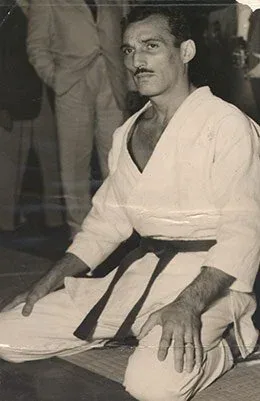
Mitsuyo Maeda, a Japanese judo master, moved to Brazil to spread the art of judo.
He met a Brazilian politician, Gastao Gracie, and made a deal with him, agreeing to demonstrate his judo techniques in several cities in Brazil, and in return, he would help Maeda become a citizen. Gastao's son, Carlos Gracie, became a student of Maeda and began teaching this martial art to his brother Helio.
Over time, they devised their own variation of judo, preferring submissions such as chokes and joint locks over throws and takedown techniques.
Brazilian Jiu-Jitsu was developed for the smaller person to defend themselves against larger opponents.
With control over one's own body (weight), leverage, and technique, there was no longer any reason why size mattered when it came to self-defense and fighting.
On November 12, 1993, Royce Gracie, Helio Gracie's son, demonstrated how effective BJJ was after winning the very first Ultimate Fighting Championship (UFC).
Royce defeated three larger opponents using Jiu-Jitsu against multiple fighting styles.
It made this new martial art, which his father Helio and uncle Carlos had been perfecting for decades, world-famous.
From that moment on, Brazilian Jiu-Jitsu spread like wildfire around the world.
Read our previous blog about the history of Brazilian Jiu-Jitsu for more information.
The origin of wrestling
The first images of wrestling were found in 15,000-year-old cave drawings in France, showing how much this sport has evolved over the centuries.
In ancient Greece, wrestling was a way to separate the wheat from the chaff.
For every young warrior, it was a way to learn self-defense and train their mindset.
The rules of wrestling were simple then.
Push your opponent out of the circle or throw your opponent and take them to the ground, and you win.
These regulations, with a few minor adjustments and technical details, have been maintained over the past decades and have since formed the basis of Olympic wrestling.
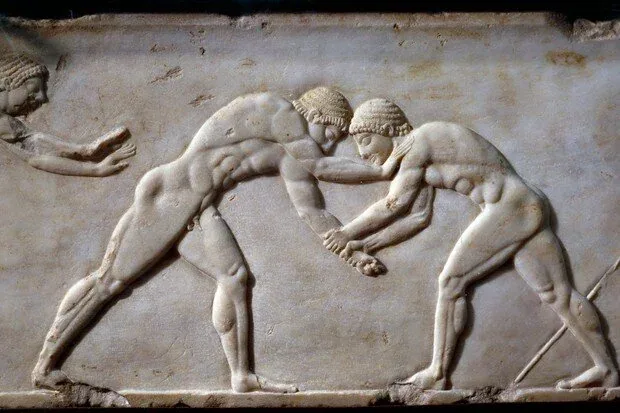
In countries where wrestling thrives, each region has its own style.
Freestyle and Greco-Roman wrestling are the most popular.
These have been officially part of the Olympic Games since 1904.
Other forms of wrestling include Sambo and Catch wrestling.
These styles share the same elements as Olympic wrestling.
Within these styles, you have the option to force your opponent into submission and pin them.
Rule differences between BJJ and wrestling BJJ
Competition rules.
There are three ways to win a Brazilian Jiu-Jitsu match:
1. Submission.
2. Points.
3. Disqualification.
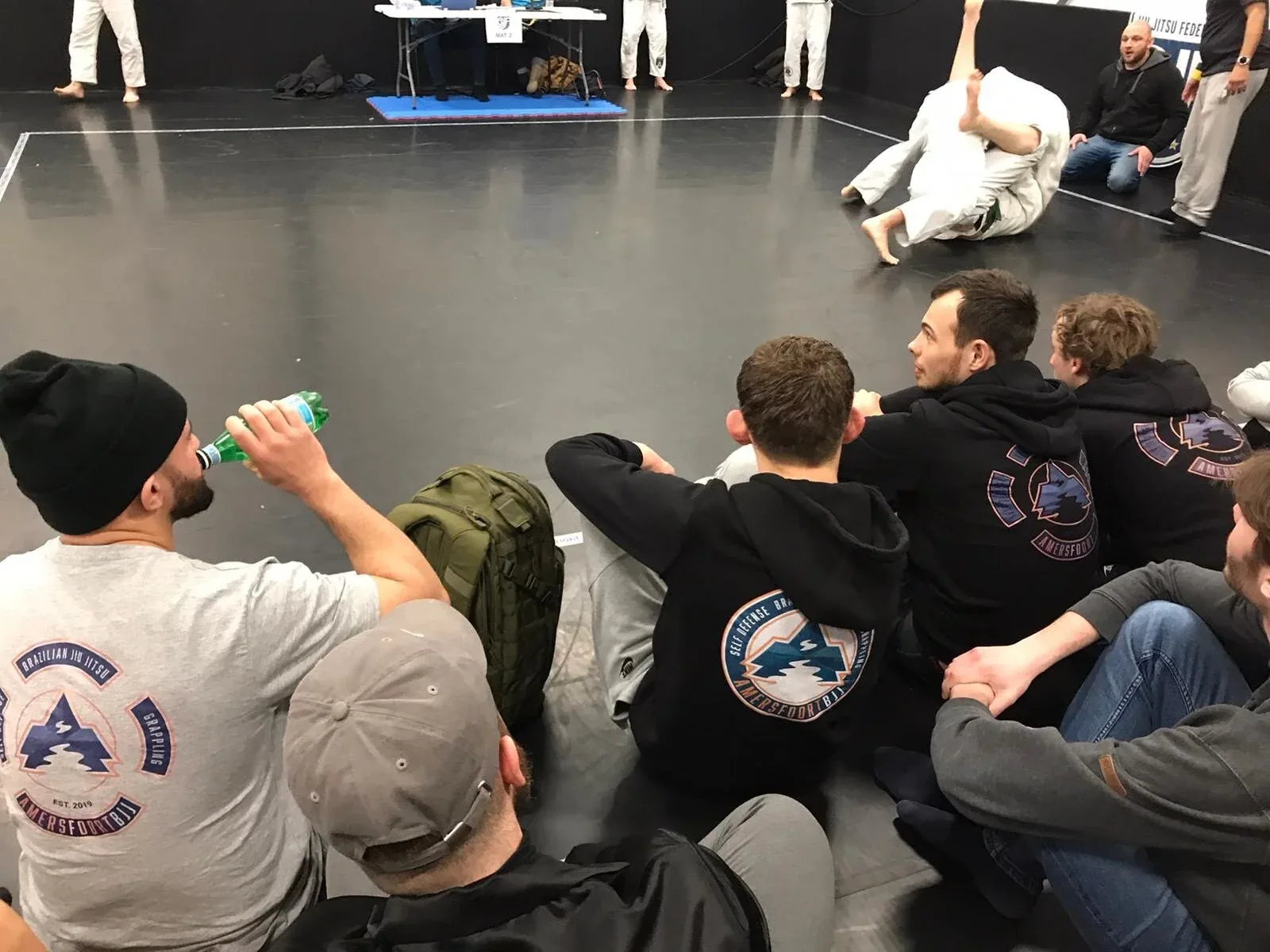
If no submission is made by the end of the match, the BJJ practitioner with the most points wins the match.
Below is the scoring system:
Throw or takedown 2 points
Mount 2 points
Knee on belly 2 points
Sweep 2 points
Guard pass 3 points
Backmount 4 points
Freestyle wrestling
In Freestyle, the goal is to get your opponent to the mat.
Preferably flat on their back.
The goal is to take your opponent down and pin their shoulders to the mat for two seconds.
Getting the pin in wrestling is equivalent to the feeling BJJ practitioners have when they get a submission.
It is then obvious who the winner is.
If you don't win with a pin when the match is over.
You can also win by decision.
This is determined by your dominance in the match.
If you have a ten-point lead over your opponent in the match, you win with a technical pin.
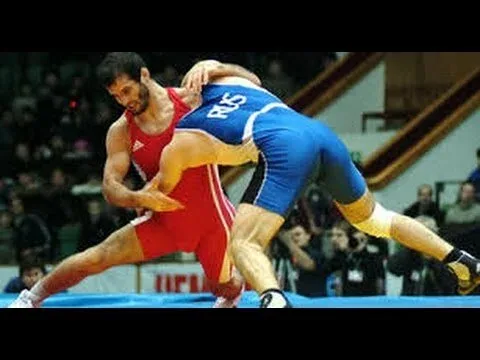
Scoring system in wrestling:
Techniques Points
Takedown 2 - 5 points
Reversal 1 point
Exposure 2-3 points
Penalty 1-2 points
Outbound 1-2 points
Takedowns
Can be scored depending on the style.
Generally, the riskier and more explosive a takedown is, the more points are awarded.
Reversal
A reversal is when a wrestler changes from a defensive position to an offensive position.
Exposure
When a wrestler puts the opponent on their back for a few seconds, but not enough to get a pin.
It does show dominance.
Penalty
Penalty points can be given for various reasons.
For example, by taking a time-out without cause, not attacking, or running around the mat.
Wrestlers receive a warning.
Three warnings = disqualified.
Outbound
If the wrestler's feet go outside the circle.
Belt system and progression in BJJ vs wrestling
Your progress in Brazilian Jiu-Jitsu depends on how often you train.
The hours you spend on the mat drilling and rolling (sparring in BJJ)
Are eventually rewarded with a belt.
Those who train more often are more likely to be promoted (logical).
Below is a good explanation of the belt system by Dave Kama.
Dave has been a student under Rickson Gracie for more than 30 years.
At Brazilian JiuJitsu Amersfoort, we teach according to Rickson Gracie guidelines.
There is no official progression system for wrestling.
Unlike Brazilian Jiu-Jitsu.
Statistics and rankings determine who the “best” wrestler is.
The more you win, the better you are.
In high school and college in America, you are matched against opponents in the same weight class.
You move up the rankings and the top 10 of each division would be the best of the best.
The NCAA is the most prestigious tournament and is divided into Division 1, Division 2, and Division 3 wrestling.
Those who wrestle at Division 1 level are the most competitive and of the highest level.
Class structure in BJJ and wrestling
A Brazilian Jiu-Jitsu class usually lasts 1-2 hours and typically follows this order:
Warm-up and drilling (30 min)
Ground drills such as forward roll, backward roll, breakfall, etc.
Technique and positional sparring (1 hour)
Techniques
Positional sparring
Sparring (30 min)
This can be from standing or already on the ground.
Sparring with contact, without striking, submissions are allowed
A round can last 5 to 10 minutes depending on your goal
Every BJJ school has its own traditions and rules.
For some, it is formal and for other schools, it is not.
BJJ Amersfoort follows the guidelines of Rickson Gracie Jiu-Jitsu.
A wrestling class lasts approximately one and a half to two hours and has a similar sequence to Brazilian Jiu-Jitsu:
Warm-up and ground drills (20 minutes)
Rolling, cartwheels, and other ground drills
Technique (55 minutes)
Technique explanation
Technique drilling
Wrestling (20 - 30 mins)
Drilling under resistance, this is intense for (30 seconds)
Sparring - 3-minute rounds
Conditioning (10-20 minutes)
Strength and conditioning drills depending on your goals
Clothing and equipment in BJJ and Wrestling
BJJ equipment
There are two ways to practice BJJ, read more in our blog about gi and no-gi .
Gi
BJJ kimono/Gi made of strong cotton.
Rash guard (prevents gi abrasion on your skin)
Mouthguard
BJJ belt
No-gi
Fight shorts/Shorts
Rash guard
Mouthguard

Wrestling equipment
What you need during a wrestling class:
Training/wrestling class
Shorts/Long pants are also allowed
Rash guard/T-shirt
Mouthguard
Ear guards
Wrestling shoes
Wrestling competition
Wrestling singlet
Mouthguard
Ear guards
Wrestling shoes
Cross-training in wrestling and BJJ
It is more common for wrestlers to train in Brazilian Jiu-Jitsu to broaden their wrestling knowledge and step out of their comfort zone.
It is less common for Jiu-Jitsu practitioners to do the same with the
standing game.
That's quite strange because at Amersfoort BJJ, we emphasize that the fight starts standing.
You will therefore find me on the wrestling mat weekly with my coaches to work on my technique.
That's why all our classes start with standing techniques.
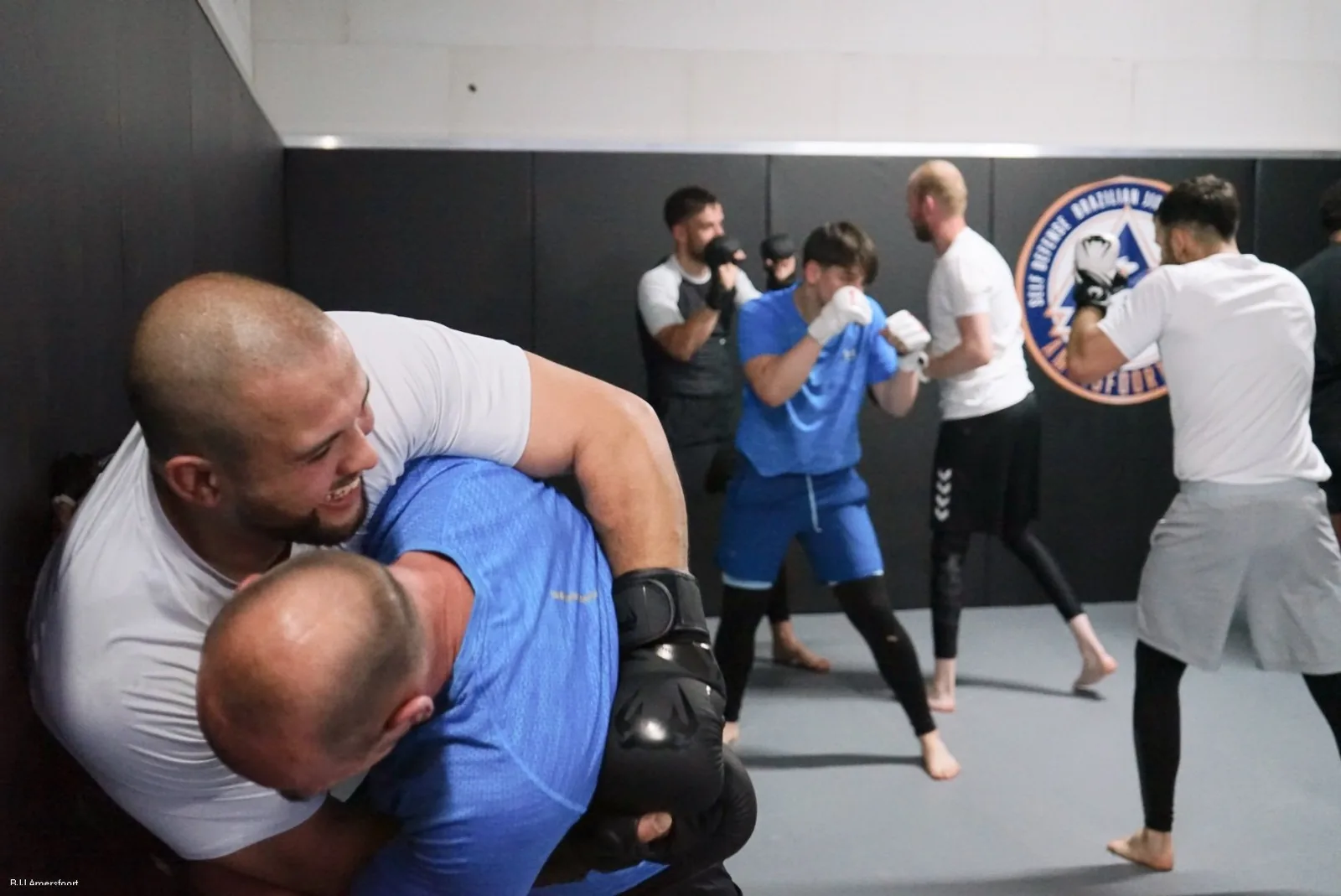
This can be self-defense, Judo techniques, or Wrestling.
Here is a short clip of respected MMA coach Firas Zahabi explaining why wrestling is essential for your BJJ.
Why you should add wrestling to your BJJ arsenal.
You develop a powerful base.
It develops strength and athleticism, which many BJJ purists lack.
It's a lot of fun, especially with submissions!
Pull guard at an angle.
Bend forward and prevent both hips from flattening on the mat. Secure butterfly hooks for maximum control.
Wrestlers tend to base out, giving you room to set up sweeps and submissions.Leg locks.
Wrestlers are often unfamiliar with leg locks.
These are also not allowed in wrestling.
You can relieve forward pressure by applying leg locks and keeping the wrestler busy defending leg locks.Kimura grips.
Kimura grips work fantastically against a wrestler applying shoulder pressure to your legs.
From this angle, you can often grab a Kimura grip.
This can be from standing or from the guard.
This works great as a sweep or reversal.Beginner-friendly. No experience needed.
Effective self-defense.
In BJJ, you learn many techniques to control an opponent and force them into submission (pain-free).Outlet.
End your day and relieve all your stress through training.
Every evening, a moment for yourself, learning something new, applying it to your BJJ buddies, and no SMART PHONE!!!BJJ is for everyone who doesn't like violence.
No one wants trouble, so you learn techniques where you don't have to hurt people.
It is also the only sport in the world where you can go 100% without hurting each other!Jiu-Jitsu fit.
Brazilian Jiu-Jitsu greatly helps to increase your fitness.BJJ is a worldwide community.
On holiday or away for work for a while, is no excuse not to train!
Because Brazilian Jiu-Jitsu can be practiced worldwide.Complex.
Jiu-Jitsu is not something you just learn; see it as a long study.Quality/Dilution of the sport.
Always research your instructor's lineage; if it's hard to trace, there's a catch!.Sport BJJ
It's beautiful to watch, but it has nothing to do with self-defense.
There is often confusion about this among beginners.
Do you want to learn self-defense?
Learn Gracie Jiu-Jitsu.
At Jiu-Jitsu Amersfoort, we follow the guidelines of Rickson Gracie.Mentality.
Wrestling training sessions are some of the toughest in the world.
If you can get through them, you can handle anything.Fantastic takedowns.
Dominate people standing and take them to the ground whenever you want!Intense workouts.
Wrestling training will get you in top shape.Control.
Wrestling is control; when you control someone, you decide what happens to them.Schools.
In countries like America, Iran, India, and Russia, wrestling is part of the culture.
In the Netherlands, wrestling is not very popular.High entry level
Wrestling is not really for "hobbyists" unlike Brazilian Jiu-Jitsu.No submissions.
The essence of wrestling is control and "pinning" people.
The fight is therefore never finished with a submission.Slamming.
In Brazilian Jiu-Jitsu, you are not allowed to slam someone.
In wrestling, you are, and that is one of its greatest dangers.
You can do this using a suplex or a dump/slam.
“Wrestling opens up a whole new dimension to your Jiu-Jitsu “
Firas Zahabi
Wrestlers can be tough opponents for BJJ purists.
It is very difficult to sweep them.
This is due to their good base.
They are tough opponents who don't give up easily.
Submissions must be applied correctly, otherwise, wrestlers will bite through the pain.
It will be a long training session if you don't have a good strategy against these types of wrestlers:
Here are some tips:
Is BJJ better than wrestling or vice versa?
So, which sport is better?
Each sport has its strengths and weaknesses.
Both Wrestling and BJJ can offer you advantages.
If we break down the discussion into subcategories, you will see that each sport specializes more in a certain area than the other.
Damian Maia is a great example of this.
Instead of just focusing on his Brazilian Jiu-Jitsu, he invested many years in wrestling.
By combining the concepts and principles of wrestling with his BJJ skills, he was able to win against one of the best wrestlers the UFC has ever seen.
BJJ Amersfoort has the pleasure of training with Damian Maia every year.
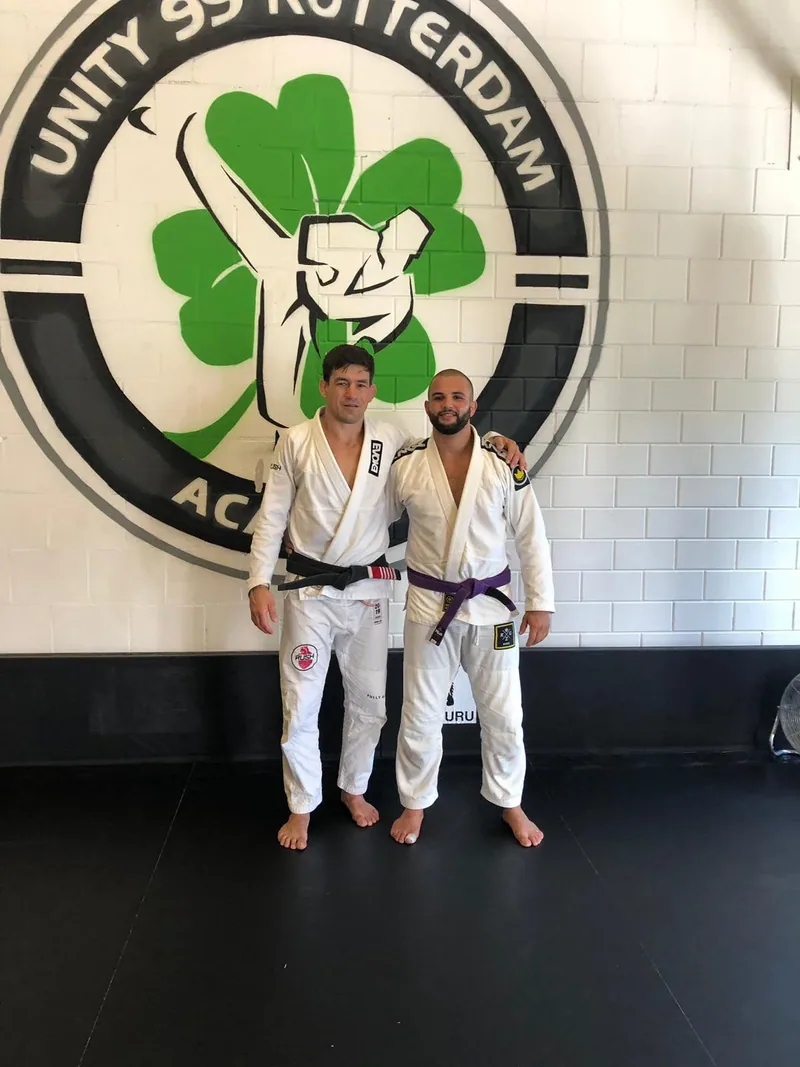
At Brazilian Jiu Jitsu Amersfoort, we also incorporate wrestling into the BJJ classes.
BJJ vs wrestling: pros and cons.
BJJ
If you are someone who has never done martial arts, BJJ is a fantastic sport to start with.
It is beginner-friendly, but at the same time, it is one of the most challenging sports you will ever try.
Mentally and physically.
Advantages
Disadvantages
Wrestling.
Wrestling is a great sport to start if you love takedowns and explosive training.
Advantages
Disadvantages
Frequently asked questions about BJJ and wrestling.
What is better for MMA? Wrestling or BJJ?
Both!
Wrestling is a great way to take your opponent to the ground and control them, then transition to ground and pound.
Brazilian Jiu-Jitsu is there to make opponents submit, even if you are on your back.
Is BJJ or wrestling better to learn if you are over 40?
Brazilian Jiu-Jitsu is recommended if you are over 40.
It is not as taxing on the body as wrestling.
Do I need to be athletic to start Brazilian Jiu-Jitsu or wrestling?
Certainly not!
That's like saying, I'll wait to learn that Spanish course because I need to know more Spanish words first!
Which is more injury-prone, wrestling or Brazilian Jiu-Jitsu?
Wrestling is more injury-prone than BJJ.
Repeatedly taking someone down from standing takes a toll on your body.
In Jiu-Jitsu, you spend more time on the ground, which is a lot less explosive.
If you want to know more about injuries in BJJ, check out our blog on the topic:
Is BJJ dangerous?
Conclusion
Both sports are fantastic to practice.
Through common currents, Wrestling and BJJ have much in common.
It is valuable to understand the differences between the two sports.
At BJJ Amersfoort, wrestling is therefore part of the curriculum.
Try both and become a resilient machine!
This article was originally published in Dutch. Read the Dutch original.