Everything you need to know about these two styles.
At first glance, it will be quite difficult for a beginner to see the difference between Judo and Brazilian Jiu Jitsu (BJJ).
Because:
In both, they wear a kimono.
From a standing position, both styles aim to take the opponent/attacker to the ground.
When you delve a little deeper, you will discover some important differences.
What are these differences? Which one is more popular?
Should you train in Judo or in BJJ, or both?
In this article, we will delve deeper into it so that you can understand it better.
History.
The reason Judo and BJJ are so similar is because they come from the same source. They are connected.
The differences are better understood if you delve into the history of both martial arts.
Both Judo and BJJ descend from traditional Japanese jujitsu
(also known as "jujutsu").
It is difficult to trace the exact origin of traditional Japanese jujitsu.
It is documented that the first jujitsu school, Takenouchi-ryū, was founded in 1532.
Jujitsu literally means 'gentle art.'
In the 13th century, it was used by the Samurai to defend themselves against armored opponents.
If they lost their weapon, they used Jiu-Jitsu.
Because the samurai wore armor, jujitsu focused on throws, joint locks, and attacking weak spots such as the eyes and groin.
In 1870, a new law was introduced which prohibited people from carrying swords in public.
This immediately marked the end for the samurai and the schools associated with them.
At the end of the 19th century, Jigoro Kano adapted JuJutsu.
He began to focus on the throws and submissions of jiu jitsu.
Kano saw Judo as a scientific sport.
He always strived for maximum mechanical efficiency in humans.
He named his new style "Kodokan Judo."
He founded the Kodokan Institute in Tokyo.
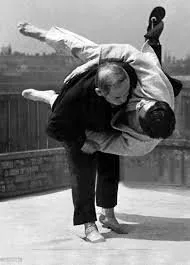
It is fair to say that Kano put Judo on the world map.
According to his biography, Kano traveled to Europe in 1889 to spread his Judo.
In 1909, he was invited as a representative of Japan to the Olympic Committee.
In 1964, Judo became an Olympic sport at the Tokyo Games.
Judo spreads to Brazil
Kano traveled extensively to spread his Judo.
But he was not the one who introduced Judo to Brazil.
This was a judoka named Mitsuyo Maeda.
Maeda was a student of Kano and first left Japan for New York in 1905 to give Judo demonstrations.
He traveled throughout North and South America, engaging in “challenge matches.”
And slowly moved south.
The Kodokan rules were simple: do not fight against other styles.
Maeda chose to do so and was expelled from the Kodokan.
Maeda arrived in Brazil around 1914 and started a school there.
Shortly thereafter, he came into contact with the Gracie brothers.
Gastao, Jorge, Oswaldo, Carlos and Hélio.
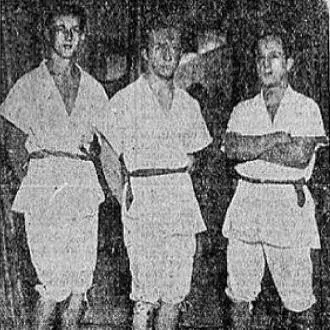
The Gracies began to focus on the "newaza" of Judo.
The ground fighting part.
The Gracies made a name for themselves with "Vale Tudo" competitions.
Vale Tudo literally means 'anything goes.'
Carlos Gracie and Hélio Gracie are the inventors/founders of Brazilian Jiu Jitsu.
Although it originated from Judo, it evolved over time into a complete self-defense system with a specialization in ground work.
In Judo, you win with “Ippon.” An Ippon is:
Throwing with impact.
Forcing a submission.
Pinning the opponent for 20 seconds.
Judokas can also score points with “Waza-ari.”
Throwing the opponent but without enough impact and not completely on their back. (Not an ippon)
Pinning the opponent for 10-19 seconds.
Usually, you win a match with two “Waza-ari.”
In Judo, many techniques are not allowed. The rules have changed; not all grips are permitted. It is also not allowed to grab the legs. Submissions are also limited. You are only allowed to attack the elbow during an armlock. Are you on the ground for too long? Get up!
Rules in Brazilian Jiu Jitsu
In BJJ, the goal is to win the match by submission.
You can also get points for certain positions.
The International Brazilian Jiu Jitsu Federation (IBJJF) awards points for:
2 points for a takedown/throw
2 points for a sweep (reversing position)
3 points for a guard pass
2 points for knee on belly
4 points for mount
4 points for back mount
If no one is submitted, the person who attacks the most wins.
Or with more points at the end of the match.
Because the rules allow it, you can spend a long period on the ground.
There, you get more points for certain positions.
So, many BJJ practitioners do not pay much attention to throwing or taking down during a match. This costs a lot of energy (Inefficient technique)
BJJ practitioners often opt for a guard pull.
Another word for pulling someone to the ground.
BJJ also allows many more submissions than Judo.
Think of armlocks, leg locks, and chokes.
It sometimes happens that BJJ practitioners do not want to improve their position; this is called “stalling.”
The referee will issue a warning so that you then have to move.
BJJ rules can vary
Depending on the tournament, BJJ rules can vary.
There are tournaments where no points are awarded.
There, it continues until someone is submitted.
Some grappling tournaments, such as the ADCC, have a part of the match where no points are awarded.
This is only done in the second half of the match.
Belt system and progression
Judo belts
The progression of Judo belts varies by region.
In most countries, there are 6 belts before the black belt.
These are the colors: white, yellow, orange, green, blue, and then brown
BJJ belts
The progression with belts in BJJ is similar to Judo, but there are fewer belts.
In BJJ, the belts go from white to blue, then purple, brown, and black
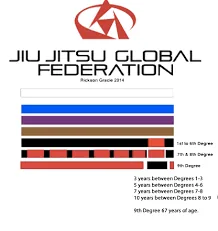
How long does it take to reach black belt?
In both sports, you will have to train for a few years to reach black belt.
Progression varies based on mat time, age, coordination, and so on.
Naturally, someone who trains more progresses faster.
5-8 years for a Judo black belt
8-12 years for a BJJ black belt
It therefore requires a lot of dedication and effort to reach a black belt.
Classes and schools.
Judo classes
Judo classes can range from one hour to two hours.
The class structure generally goes something like this:
Warm-up (bodyweight exercises, rolling, breakfalling, and stretching)
Technique and drilling with your partner
Randori (sparring)
Many Judo classes have a tachi-waza (standing) section separate from a newaza (ground) section.
BJJ classes
BJJ classes follow a similar structure to Judo classes.
In most schools, it goes in this order:
Warm-up (jogging, rolling/shrimping, basic BJJ movements)
Technique and drilling with a partner
Rolling (sparring)
Each BJJ school has its own traditions and rules.
At some, it is formal, and at other schools, it is not.
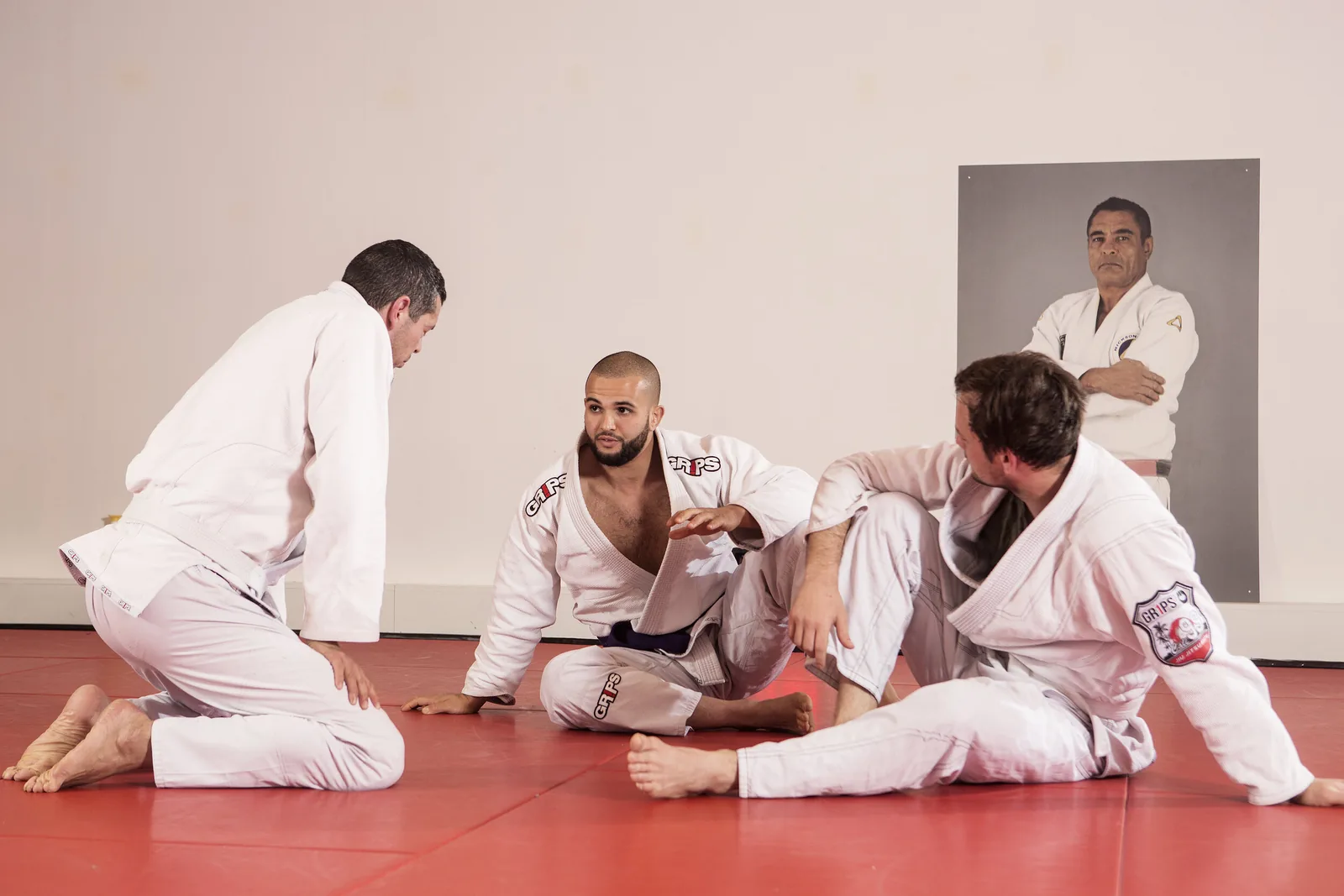
BJJ Amersfoort follows the curriculum of Rickson Gracie Jiu-Jitsu.
Clothing and equipment.
BJJ and Judo kimonos look similar.
But there are a few differences.
The Judo kimono (or gi) is heavier and more durable than a standard karate or taekwondo uniform, because it is built for gripping and throwing.
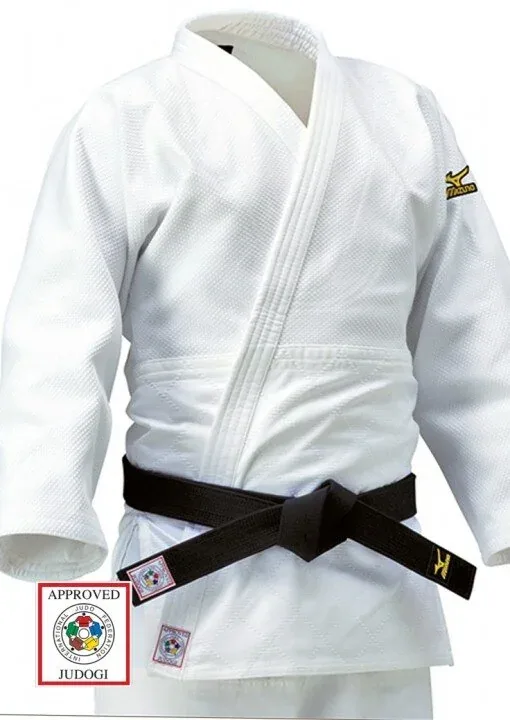
A BJJ uniform is heavier and more durable than a Judo uniform, because it has to withstand even more wear and tear from all the submissions and throws.
The uniforms are often extra strongly woven.
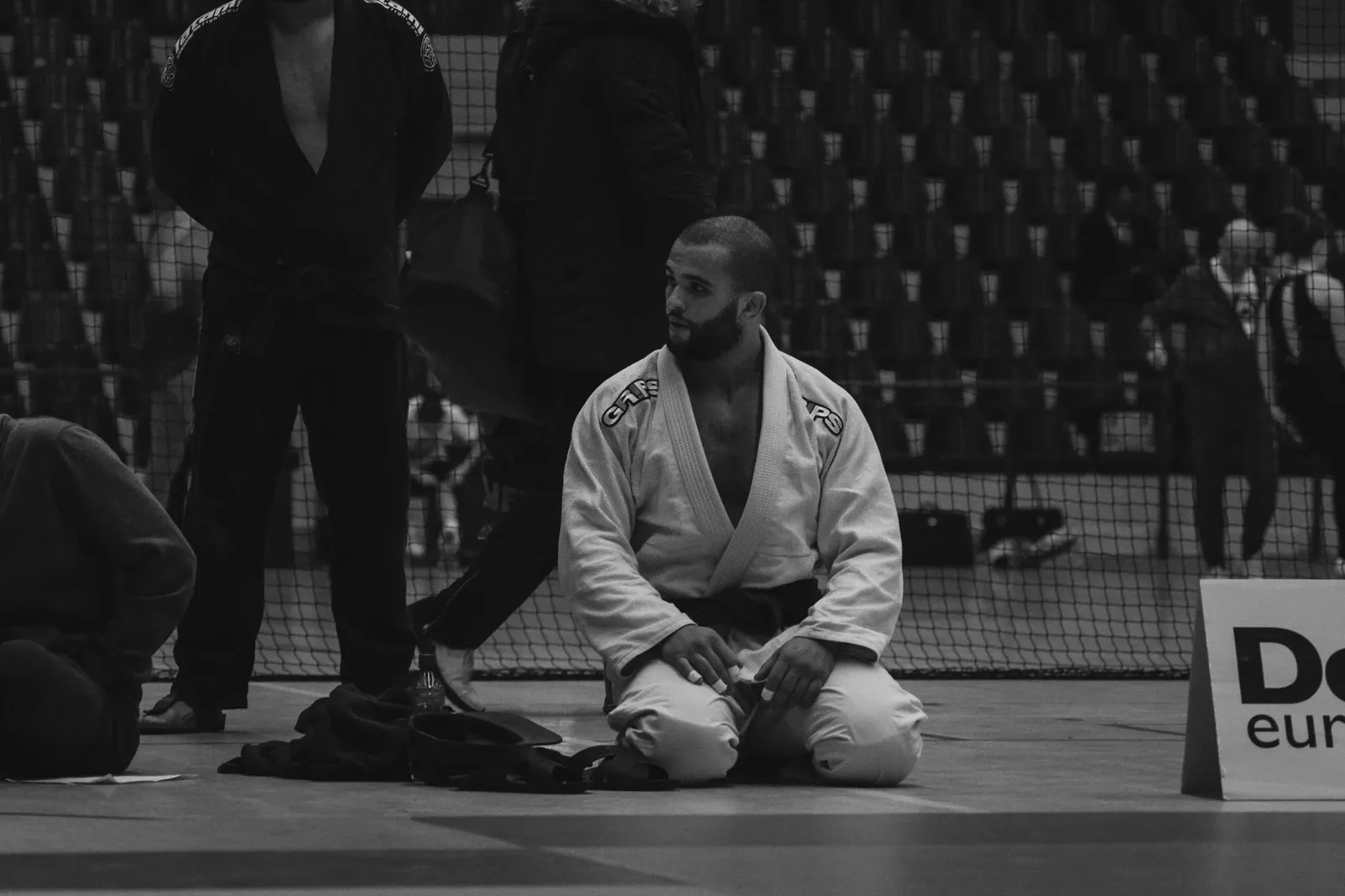
Jiu Jitsu generally has more gi colors to choose from.
The IBJJF allows white, blue, or black kimonos in tournaments.
In Judo, only white is allowed.
Each BJJ school has its own rules regarding GI color.
At BJJ Amersfoort, we prefer a white or blue Gi.
You can also do BJJ without a uniform, which is called No-Gi.
You can read about it in gi vs no gi jiu jitsu.
Cross-training in BJJ and Judo
Judokas spend most of their time on the standing part.
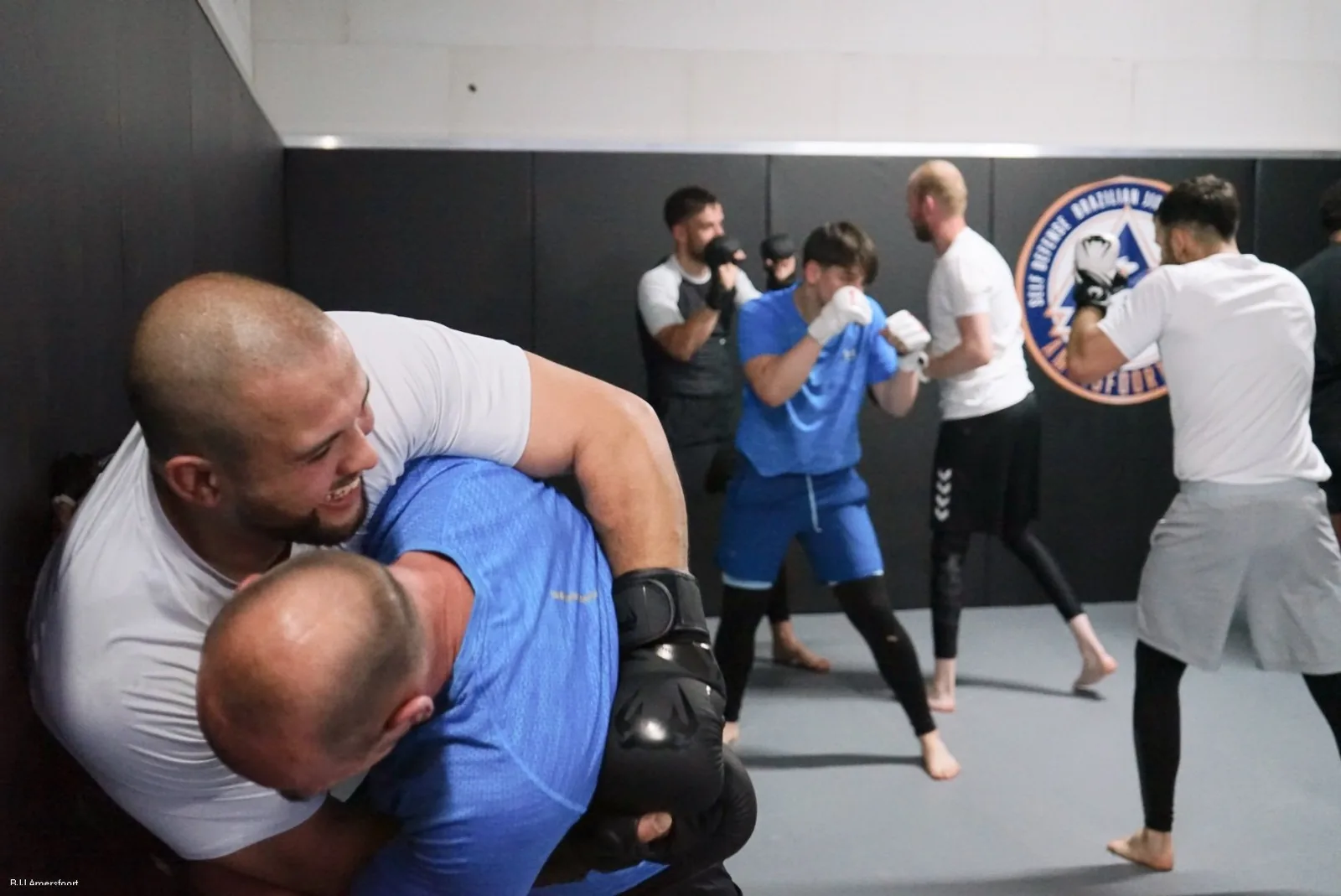
BJJ practitioners spend most of their time on the ground (BJJ Amersfoort 50/50).
The techniques and competition strategies of a Judoka can complement those of a BJJ practitioner.
It is therefore useful to learn from each other.
In a sense, this can help to accelerate your progress even faster.
What is better, Judo or BJJ?
So, which sport is better?
Each sport has its strengths and weaknesses.
Both Judo and BJJ can offer you advantages.
If we break down the discussion into subcategories, you will see that each sport specializes more in a certain area than the other.
Self-defense
Both sports were originally self-defense sports.
Unfortunately, over time, it has become more watered down.
Both in BJJ and Judo.
It also depends on your style.
For example, at Amersfoort BJJ, we are committed to you being competent in self-defense. This is the philosophy taught to me by Rickson Gracie.
So, if I had to choose one that is better for self-defense, I would give BJJ the edge.
This is because Judo has more rules, for example, you are not allowed to grab the legs.
These kinds of limitations can be fatal in a street fight.
Because on the street, anything goes ;).
Judo is also very dependent on the Gi.
In BJJ schools, you usually have a few no-gi classes every week.
In BJJ, it is allowed to use all effective standing techniques.
Whether they come from Judo, Wrestling, or Sambo, it doesn't matter much.
What works, works!
Finally, since you spend more time on the ground in BJJ (newaza),
with more submission options, the average BJJ practitioner will be better able to defend themselves if the fight goes to the ground.
Fitness
This is a difficult question to answer because there is little data to analyze.
At BJJ Amersfoort, we conducted a calorie burning test during a BJJ session.
Based on that data compared to calorie burning data from other sports, it appears that a BJJ session with the same amount of sparring time will burn slightly more calories than Judo.
(Our research showed that BJJ sparring burns 557 calories per 30-minute session, compared to 397 calories from a 30-minute Judo session.
Of course, these figures are highly dependent on characteristics such as the school's style, training partners, and so on.
Ultimately, both are excellent calorie-burning sports.
BJJ vs Judo: Pros and Cons
Now it's time to summarize the similarities, differences, pros, and cons of Judo and BJJ.
Let's first look at some of the similarities between the two, as they are quite similar in many respects:
Similarities BJJ vs Judo
Judo BJJ
Physical and mental training X X
Self-defense X
Self-confidence X X
Competition X X
Safe X X
Grappling X
Community X X
Differences BJJ and Judo
Judo BJJ
Cheaper X
Best for self-defense X
Olympic sport X
Best standing technique X
Best for ground technique X
Frequently asked questions about BJJ and Judo
What is harder to learn, Judo or Jiu Jitsu?
Both are difficult to learn.
If we are talking about the basics, Judo is probably harder.
It takes time to develop essential timing and footwork.
BJJ has more depth and takes longer to learn (once you've mastered the basics).
What is physically more demanding?
In both sports, you have a chance of getting injured.
Because Judo is primarily about throwing, this can be very demanding on the body. Being thrown over and over again, even on good mats, takes its toll.
That being said, BJJ can certainly damage the body too, especially if someone is reluctant to tap quickly.
What is better for children?
The children should primarily have fun.
It doesn't matter where that is!
Both are optimal, of course.
Conclusion
Both sports are fantastic to practice.
Due to common lineages, Judo and BJJ have a lot in common.
It is valuable to understand the differences between the two sports.
Try both and become a resilient machine!
This article was originally published in Dutch. Read the Dutch original.