You googled Brazilian Jiu-Jitsu because it's quite popular now due to the UFC and MMA. You come across photos and videos of people just 'doing stuff' on the ground. 'This is not for me,' you think, and it looks strange too. In this article, I will explain to you that it's not strange at all, what we do, and the thought process behind the techniques.
What is the objective in BJJ?
Survive. Some people may disagree with this, and that's fine. The foundation of Brazilian Jiu-Jitsu has always been self-defense, and we can all agree on that. For us at Amersfoort BJJ, self-defense and survival go hand in hand.
Defense: If you are attacked, defend yourself at all times.
Self-defense processes.
Large: Imagine someone standing in front of you, trying to hit you with a huge right hook. If you manage to evade it by ducking under and grappling the attacker, the major threat has been avoided.
Small: Now you have control of the attacker; this is the moment to make small, short movements and maintain control over him/her.
Deep: You are now behind the attacker and have hold of their waist, but forget to press your head against their shoulder blade. Suddenly, you get two hard elbows to your temple or jaw. This means you ignored the small steps and are now experiencing the consequences. This is not the end of the exercise, of course; you can now take the step to bring the fight to the ground with a simple (not easy) takedown technique.
You primarily want to focus on the large and small principles to prevent the greatest damage or trauma. Prevention is better than cure!
Escape:
Accept: You accept that you have ended up in a bad position, which prevents greater panic.
You also accept the attacker's mistakes, which means you will start to see opportunities and openings.
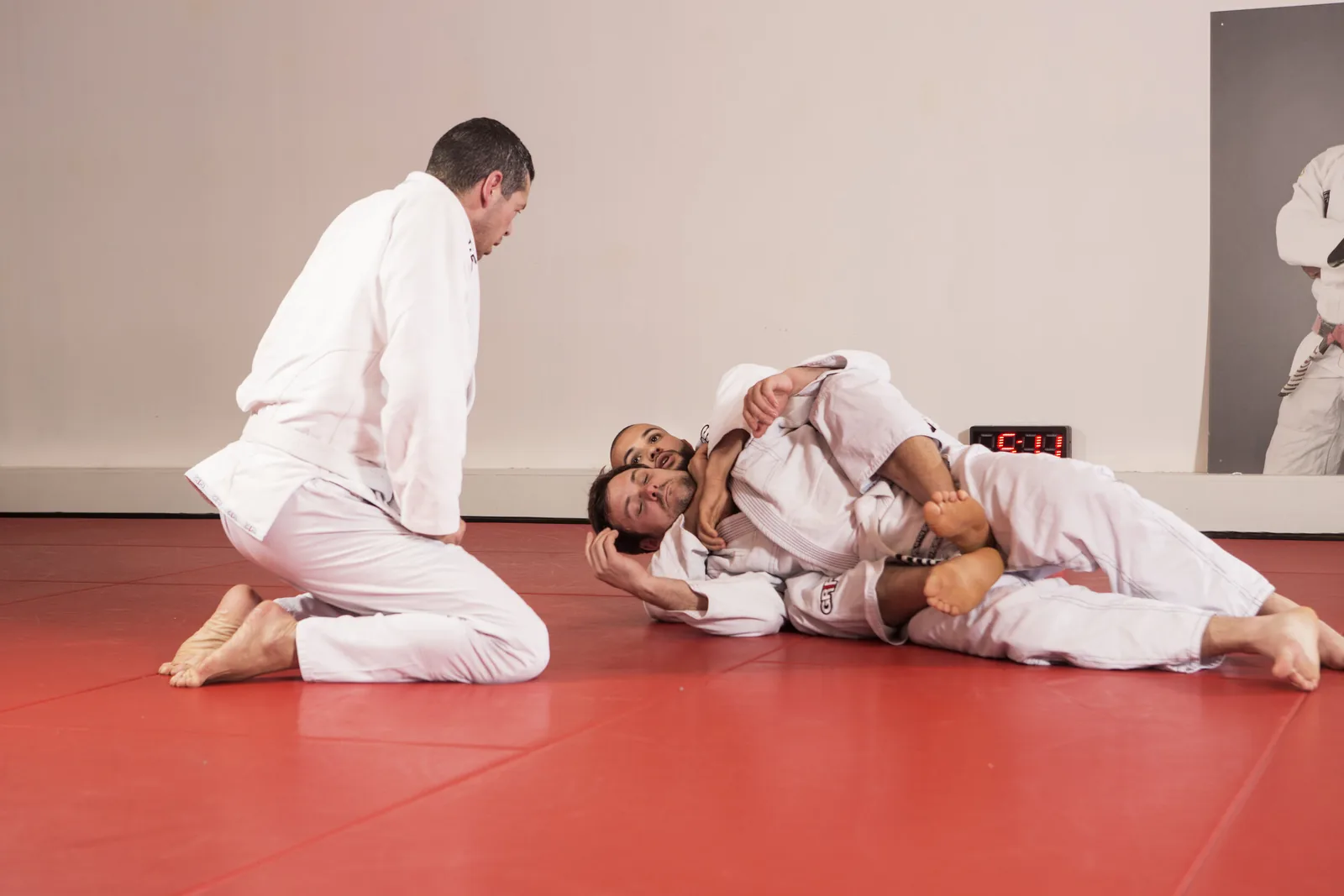
Scenario: someone is on top of you, trying to choke you. You reverse the position. The attacker is leaning too far forward; you can use a bridging movement to reverse the position and get on top, escaping the situation.
Create: You can create an escape by letting the acceptance phase happen in combination with two or three beginner Brazilian Jiu-Jitsu techniques.
If you are sparring or rolling with an experienced Jiujitsuka during class, as we call it, that's a different story. But that's what makes it so interesting, and why people like to return to our classes to get a little better every day.
Force: Forcing is a phase you would ideally want to avoid.
Every situation is different, but it's unlikely that someone will hold onto you on the street and not let go. In most cases, they want to hurt you with punches, knees, or kicks (even if you're on the ground).
These kinds of escapes then involve a lot of strength and explosiveness, provided you haven't mastered the Jiu-Jitsu techniques.
Control:
Closed
You can control a person on the ground in multiple ways.
Closed control means you are holding someone and don't want to let go.
This is what someone with no BJJ experience will do; we often see this in trial classes.
Open: This form of control primarily involves weight distribution and the pressure you exert with your body weight on the person you want to control on the ground. The more experience you have with Brazilian Jiu-Jitsu, the better you can do this. We also teach you this at BJJ Amersfoort in our classes.
Dynamic: Here, you control the attacker with more movement; this is accompanied by submission attacks. You can think of an armlock or a choke. This can also be done with a few open hands; we don't really want to hurt the attacker but rather give them the idea that it's better to keep calm and that you have control over him/her.
Submission:
Accept: The best way to submit someone is always in a controlled manner.
Scenario: The person tries with all their might to escape and will make large movements to get away. For someone experienced in BJJ, these are mistakes that you will turn to your advantage to get the submission.
Create: This is more for experienced Jiujitsukas who train with other Jiu-Jitsu practitioners who won't make as many mistakes. This involves more movement and combinations to create a reaction so that the person will make a mistake leading to the submission.
Force: You would rather avoid this, especially with your training partners, though there are always exceptions.
Scenario: You find yourself in a threatening situation on the street where you are being attacked. The attacker won't let go; the only way you can get free is by forcing a wrist lock, causing his/her wrist to bruise or break. Permitted or not? You may answer this question for yourself.
We can give you a good foundation and awareness of these self-defense concepts in four weeks.
Sign up now for a no-obligation trial class
This article was originally published in Dutch. Read the Dutch original.