Weekly I get the question: is Brazilian Jiu-Jitsu (BJJ) dangerous?
Because BJJ seems unsafe to an outsider.
That is to be expected when one hears about joint locks and chokes.
It sounds scary and unpleasant. In this article, we will delve deeper into it.
The most common injuries in Brazilian Jiu-Jitsu
According to a recent study based on 2511 BJJ competitions in Hawaii,
it has been shown that Brazilian Jiu-Jitsu had the fewest injuries in competition.
The comparison was made between BJJ, wrestling, Judo, MMA, and Taekwondo.
The study shows that there were only 46 injuries from a total of 5022 matches.
The most common injuries in these matches were sprains.
Injuries resulting from BJJ training over the years show different outcomes.
The injuries are shoulders, knees, skin, hands and fingers, feet and toes, rib cage, arms and elbows.
Read on to see the most common BJJ injuries.
The techniques that cause the most injuries and tips to reduce injuries.
Article content:
BJJ competition injury statistics
Brazilian Jiu-Jitsu injury statistics in training
General training injuries
The big question: what causes more injuries, training or competition?
Which techniques cause the most injuries in BJJ?
BJJ injuries compared to other martial arts: which martial art has the most?
Is BJJ tough on your knees?
Tips for minimizing injuries in Brazilian Jiu-Jitsu
Several studies have investigated the most common injuries in BJJ training and competition.
In BJJ competitions, the aforementioned study by Scoggin et al. found that the most common injuries were orthopedic injuries, specifically injuries to bones, joints, muscles, tendons, and ligaments.
According to this study, there were 46 injuries out of 5022 matches. Of those 46, the most common injuries were:
BJJ competition injury statistics
Elbow: 14
Knee: 7
Rib or costochondral fractures: 7
Foot and ankle:5
Hand: 5
Shoulder:4
Lacerations requiring medical care:3
Hip: 1
Cervical:1
Source (translated)
Note: heel hooks were not allowed in these competitions.
Brazilian Jiu-Jitsu injury statistics in training
BJJ athletes and hobbyists will generally spar more often in the dojo than they do in competitions.
It is therefore worthwhile to investigate the number of injuries.
We look at injuries sustained during training or injuries sustained over a longer period, also called overuse injuries.
Many of these studies are based on questionnaires given to martial artists.
There are three interesting studies that have been examined regarding treating injuries in BJJ during training.
All three had different outcomes.
This 2019 study shows that the top three injury areas were the knees, shoulders, and rib cage.
This 2018 study shows that shoulder and knee injuries were the most common injuries among 180 beginner and advanced BJJ athletes.
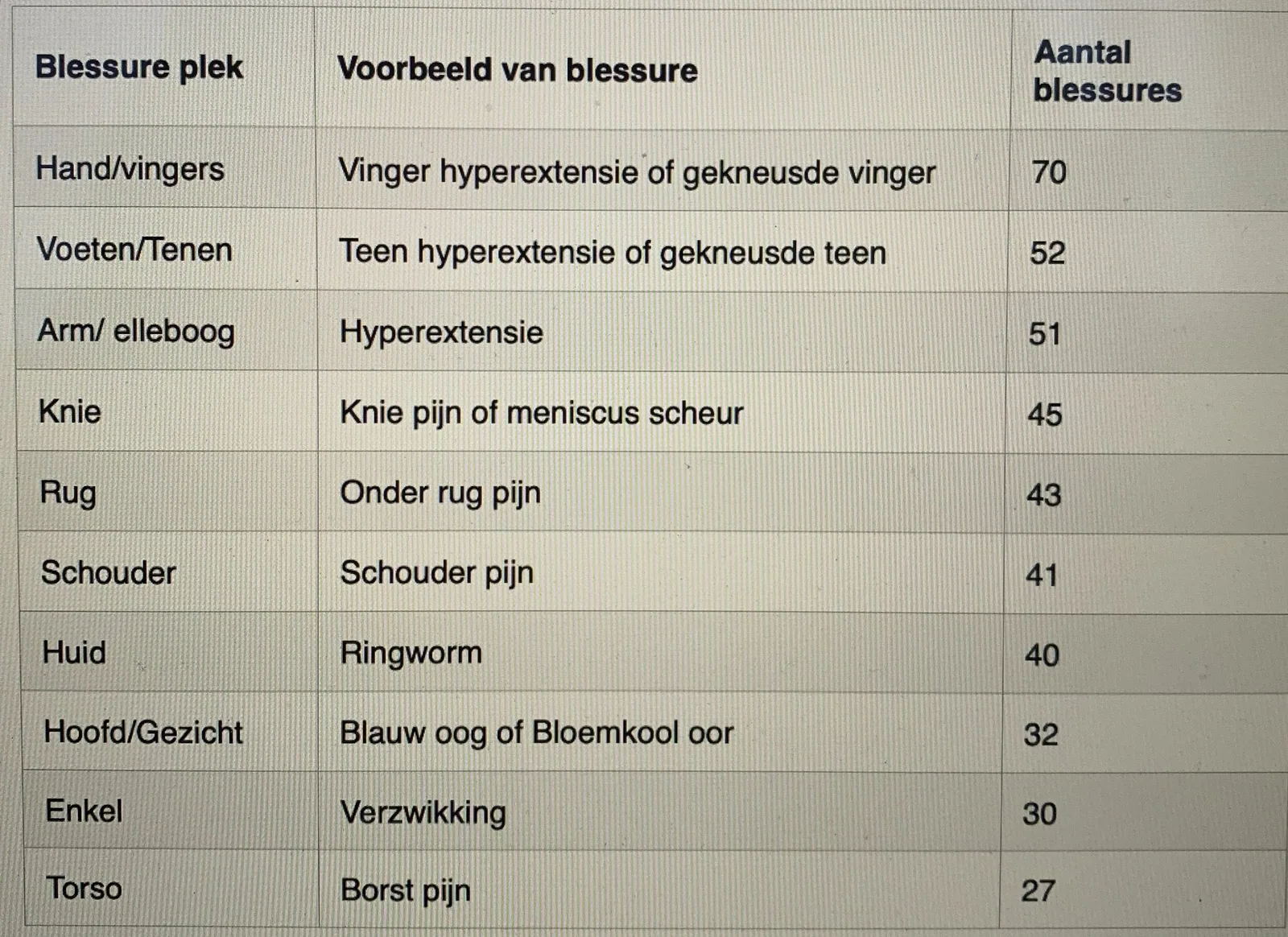
This 2017 study shows that the three most common injuries were hands, feet, toes, arm, and elbow. The outcome of this study is that the most common injuries are skin infections, knee, foot, and toe.
2017 study Prevalence of Injuries during Brazilian Jiu-Jitsu Training by McDonald et al. can be viewed below:
General training injuries
Source (translated)
The 2019 study above by Moriarty et al. found that 59.2% of the surveyed athletes had sustained at least one injury within six months at that time.
It also showed that those who were heavier with more experience had fewer injuries (Finally, being heavy is an advantage).
Those who took more classes or were an instructor had an increased risk of injuries.
The big question: what causes more injuries, training or competition?
The 2018 study above looked at injuries in beginner and advanced athletes. It showed that training injuries were slightly higher than competition injuries for beginners.
Advanced athletes showed the opposite:
Level Training Competition
Beginner athletes (injury %). 54.5% 45.5%
Advanced athletes (injury %) 33.9% 66.1%
Which techniques cause the most injuries in BJJ?
According to this study by Scoggin et al.,
based on over 2500 matches in Hawaii, most injuries were caused by the armbar, followed by takedowns.
The armbar caused elbow injuries 10 out of 14 times in the study due to powerful hyperextension.
The study found that elbow injuries from armbars were generally caused when the participant resisted by not tapping quickly enough (not smart).

BJJ injuries compared to other martial arts: which martial art has the most?
According to this 2014 study of statewide BJJ competitions in Hawaii from 2005 to 2011, BJJ has fewer injuries compared to Judo, MMA, Taekwondo, and Wrestling.
The study compared injuries per 1000 athletes in competitions to see which martial art had the highest number of injuries.
The study showed that BJJ had the lowest injury rate per 1000 athletes:
Martial art Injury rate per 1000 athletes
Brazilian Jiu-Jitsu (BJJ). 9.2
Wrestling 9.0 - 30.7
Taekwondo 20.5 - 139.5
Judo 25.3 - 130.6
Mixed martial arts (MMA) 236 - 286
Source (translated)
Is BJJ tough on your knees?
Knee injuries are more common in Brazilian Jiu-Jitsu.
I myself sustained a knee injury in the early stages of my BJJ training.
I was out of commission for a few weeks but was able to train through it well with certain restrictions.
Technique training and drilling are usually good options if you are injured, discuss this with your instructor!
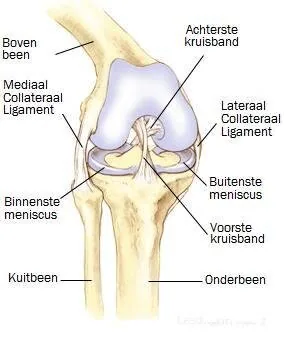
According to this study on 2014 Hawaiian BJJ competitions, most competition injuries were to the medial collateral ligament (MCL) and lateral collateral ligament (LCL), the same type of sprain. The MCL runs along the inside of the knee, and the LCL runs along the outside of the knee.
Tips for minimizing injuries in Brazilian Jiu-Jitsu
Every sport has injuries, and Brazilian Jiu-Jitsu is no exception. Here are a few tips to prevent them:
Tap on time. In one of the studies, it was mentioned that the injury caused by the armbar resulted from NOT tapping on time.
Know the dangerous positions. At my BJJ school, we have a policy where heel hooks are not allowed for white belts; you give someone time to tap.
If you injure that person, it is YOUR responsibility. Learn the mechanics and risks of heel hooks. Personally, I find the Kimura more dangerous than a heel hook for white belts.Be aware of common injuries and skin infections.
Knowing the most common skin infections can be helpful in preventing them in the future. This should reduce their spread.Choose the right training partners.
This is a phrase you hear in BJJ schools worldwide.
I'm not a fan of this.
The atmosphere in your school is determined by the instructor.
EVERYONE must have control over their body and be responsible for their partner, as described in point two.Avoid overtraining. In this study on BJJ athletes, it was shown that overtraining is the biggest cause of injuries (66%) among beginners.
This article was originally published in Dutch. Read the Dutch original.