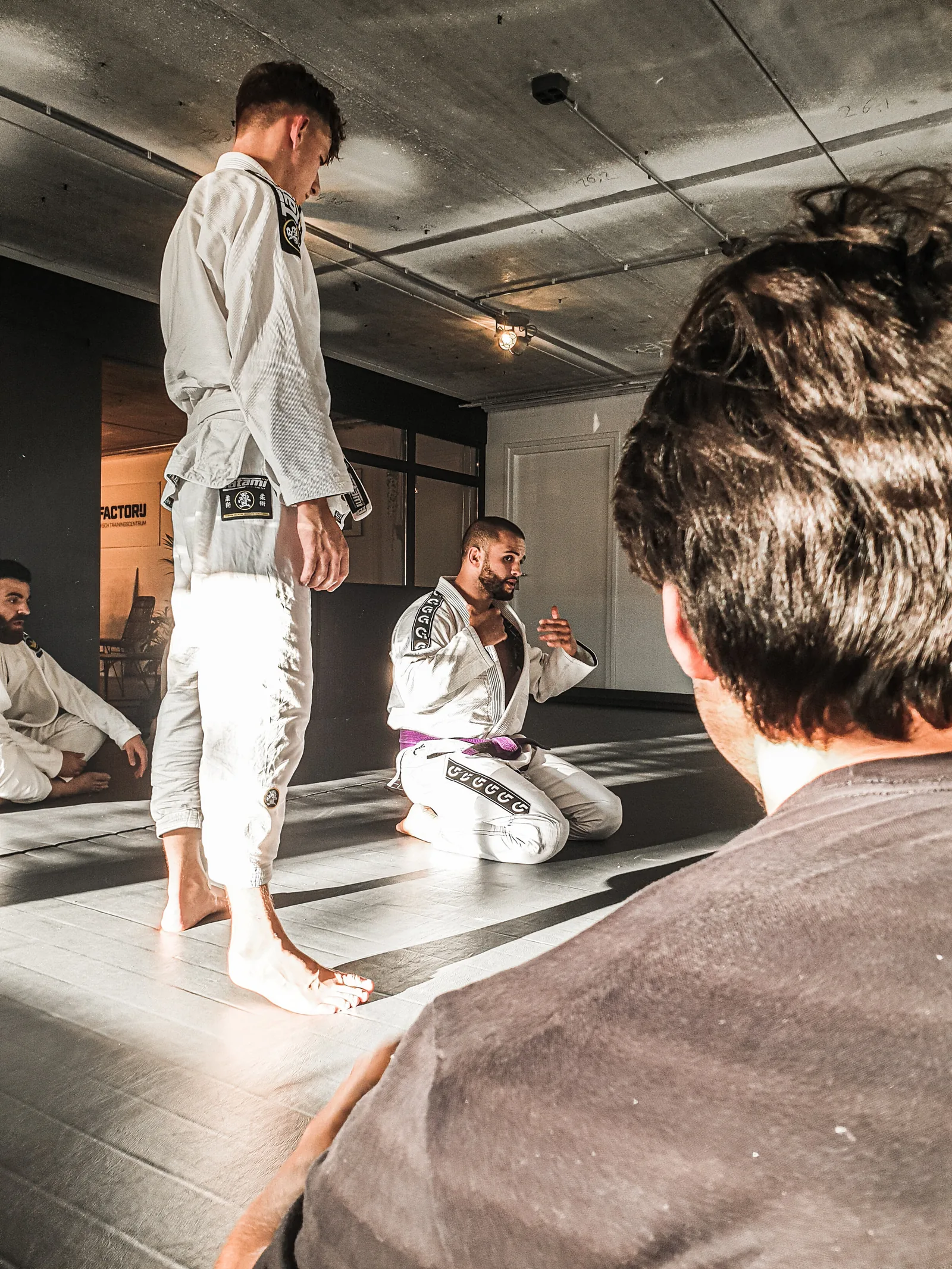
BJJ competitions can be a lot of fun.
Many of the modern Jiu-Jitsu techniques used in competitions are not very useful for the street.
When the Gracie family initially developed Brazilian Jiu-Jitsu, it was intended as a self-defense system, not as a way to win competitions on points.
This, of course, does not mean that BJJ students do not have to participate in a competition or do not learn sport-specific BJJ techniques.
That is why we at BJJ Amersfoort want our students to become competent in both, which means learning self-defense techniques and winning competitions.
In this blog, we will give you 8 indispensable BJJ techniques for the street.
1: Technical standup:
You won't get many likes for it on social media, but knowing how to efficiently get up from the ground is quite an important self-defense skill.
Therefore, all BJJ practitioners must master the technical stand-up.
The technical stand-up is a technique used to go from a sitting to a standing position without taking too many hits.
Often, people who are knocked to the ground during a fight do not have a safe way to get back up.
The technical standup is then a very useful concept.
Below you can see an example in practice.
Takedowns:
It sounds much better in English than in Dutch.
Takedowns, that is, taking someone down/throwing them.
3: The mount.
If you take down the attacker in a self-defense situation as described above.
Then it is important that you can maintain the top position.
If your opponent takes you down and ends up on your chest, you need an effective way to get him or her off you.
To make sure you are prepared for the street, you need to practice escaping the mount extensively.
You will learn this in classes at Amersfoort BJJ.
Here are four tips from BJJ in Amersfoort for maintaining the mount in a self-defense situation:
1: Focus on balance.
2: Use your hands if necessary and place them on the ground when your opponent tries to push off.
3: Put your feet under the sides of the opponent.
4: Lower your hips.
4: Mount escape.
Understanding how to escape the mount is just as important as knowing how to maintain the mount.
If you end up on the bottom in a street fight, you need to know how to get out of it.
One of the first escapes you learn as a BJJ student at Amersfoort Jiujitsu is bridging and rolling.
This movement allows you to literally turn the tables.
5: Back mount control:
Back mount is the strongest position in BJJ.
Why?
You are behind your opponent, unless they have 4 arms, you are at an advantage!
This gives you opportunities for chokes and joint locks from behind.
Do you only want to use it for control until help arrives?
Then this is a good middle ground, your opponent can almost impossibly hit you from that position.
6: Rear naked choke (RNC)
The rear naked choke is an excellent technique for the street.
We at BJJ Amersfoort believe that chokes are more effective in self-defense situations than joint locks.
Imagine someone attacking you on the street.
The fight ends on the ground and you apply an armbar, the person does not want to tap and does not feel the pain because they are under the influence.
Think of someone who has used cocaine or other hard drugs and is numb, they feel nothing from a broken arm.
This is a frightening moment because he/she continues to attack you.
When you apply a choke, the attacker will lose consciousness, giving you the chance to get away safely.
Writing this paragraph takes more time than choking someone.
Five to eight seconds and you are gone.
7. Guillotine Choke:
Another excellent choke for the street is the guillotine.
The beauty of this choke is that it can be applied from a standing position.
So, if you cannot get your attacker to the ground or do not want to take your opponent to the ground, the guillotine is an excellent option to end the fight quickly.
8. The Clinch:
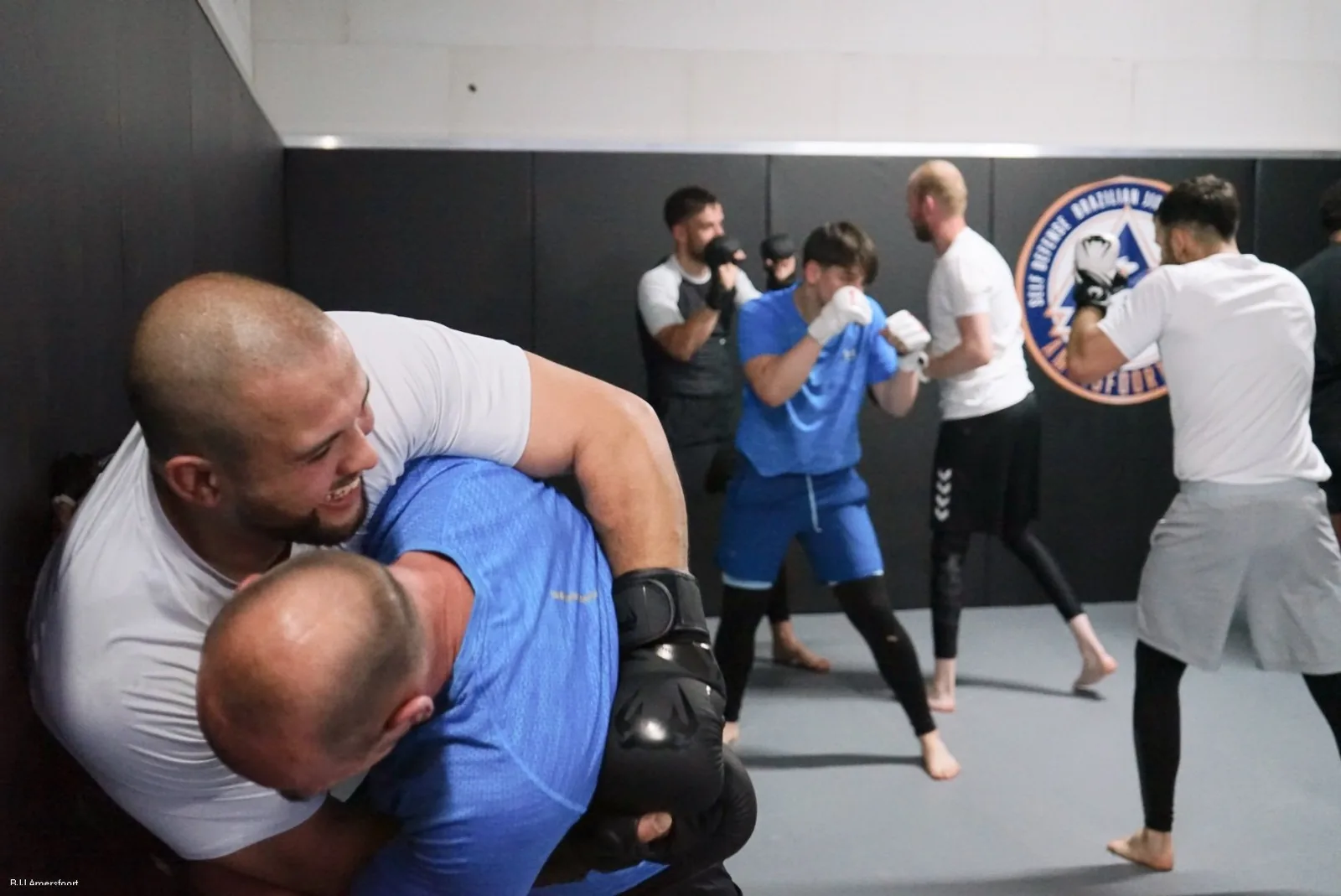
The clinch is a standing position where two people grapple with each other. Therefore, if you practice Jiu-Jitsu for self-defense purposes, it is important to have a good understanding of the clinch.
With the clinch, you can not only neutralize an attacker on the street, but it also protects you from punches and kicks.
By controlling your opponent in the clinch, it becomes much easier to execute your attacks while staying safe because you are very close.
See video
Become resilient!
Fortunately, most people who learn BJJ will never have to use it on the street.
However, that does not mean you do not need to learn self-defense techniques.
In an ideal world, you can always avoid violence.
Not in our world.
And in such cases, resilience is a great asset.
Naturally, within the frameworks of proportionality and subsidiarity.
If you are interested in learning BJJ and resilience to protect yourself on the street, sign up for a trial class today!
Free trial classThis article was originally published in Dutch. Read the Dutch original.