In this blog, we discuss the main similarities and differences between these two styles.
Brazilian Jiu Jitsu and Japanese Jiu Jitsu are often confused with each other.
Although they have similarities in techniques and history, they are also different in many ways.
In this blog, I will explain the similarities and differences.
Table of Contents
The differences between BJJ and Japanese Jiu Jitsu
History and origin of BJJ and Japanese Jiu Jitsu
Rules
Differences in belt system and progressions
How long does it take to get a black belt in Brazilian Jiu Jitsu vs Japanese Jiu Jitsu?
What are the differences in knowledge between a BJJ black belt and a Japanese Jiu Jitsu black belt?
Apparel and equipment
Is BJJ better than Japanese Jiu Jitsu?
What is the most effective style?
BJJ vs Japanese Jiu Jitsu: pros and cons
The main differences between BJJ and Japanese Jiu Jitsu.
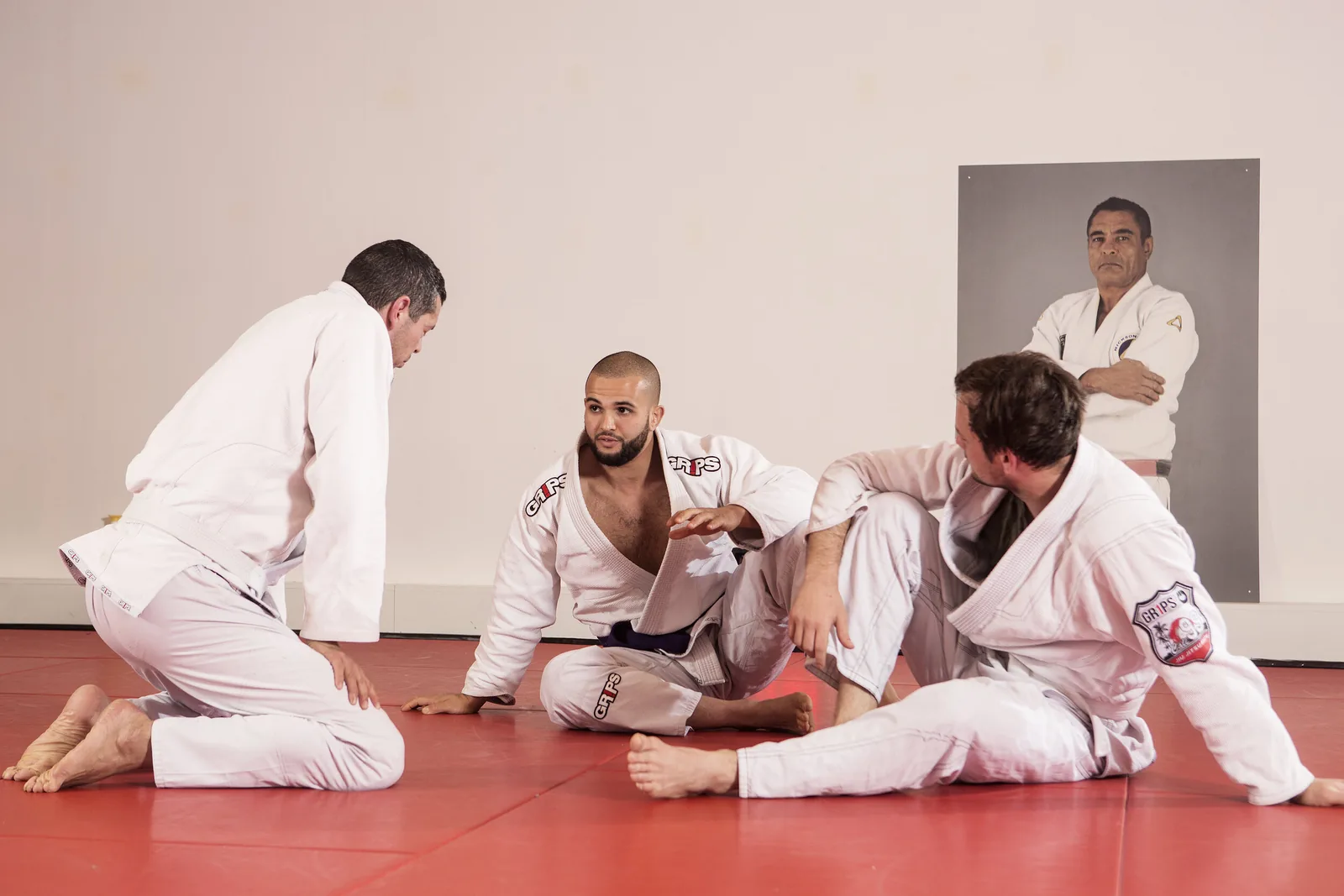
Brazilian Jiu Jitsu focuses on grappling.
The fight primarily takes place on the ground. Standing = self-defense.
BJJ practitioners use chokes and joint locks to submit opponents.
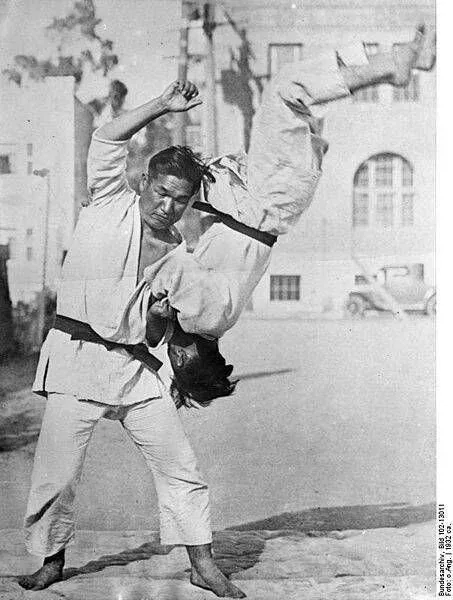
Japanese Jiu Jitsu primarily focuses on throwing opponents.
Joint manipulation, striking, and blocking.
Some styles also include traditional Japanese weapons during training. In BJJ, we use takedowns to get opponents to the ground.
Then, you gradually work towards a dominant position.
We usually do this in four steps.
Take your opponent to the ground (if they get too close)
Pass the legs (legs are dangerous even with an untrained person)
Control the person by pinning them.
Negotiate, you always have the option for a choke or a joint lock.
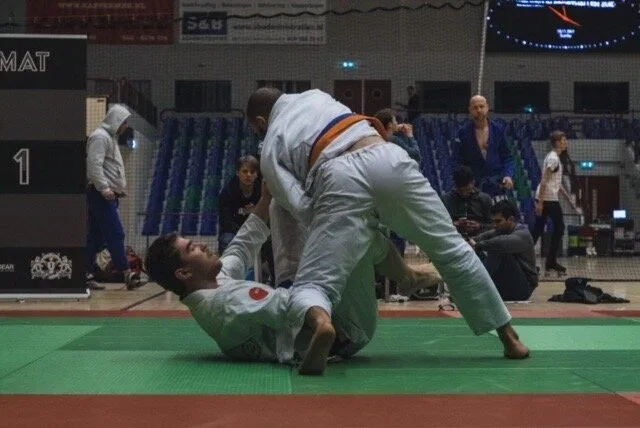
BJJ has enough competitions worldwide annually for you to participate in.
The disadvantage of this is that many BJJ schools therefore focus on competitions and points, causing the essence of the sport, being able to defend yourself on the street, to be lost.
At Amersfoort BJJ, it is therefore mandatory to be competent in both.
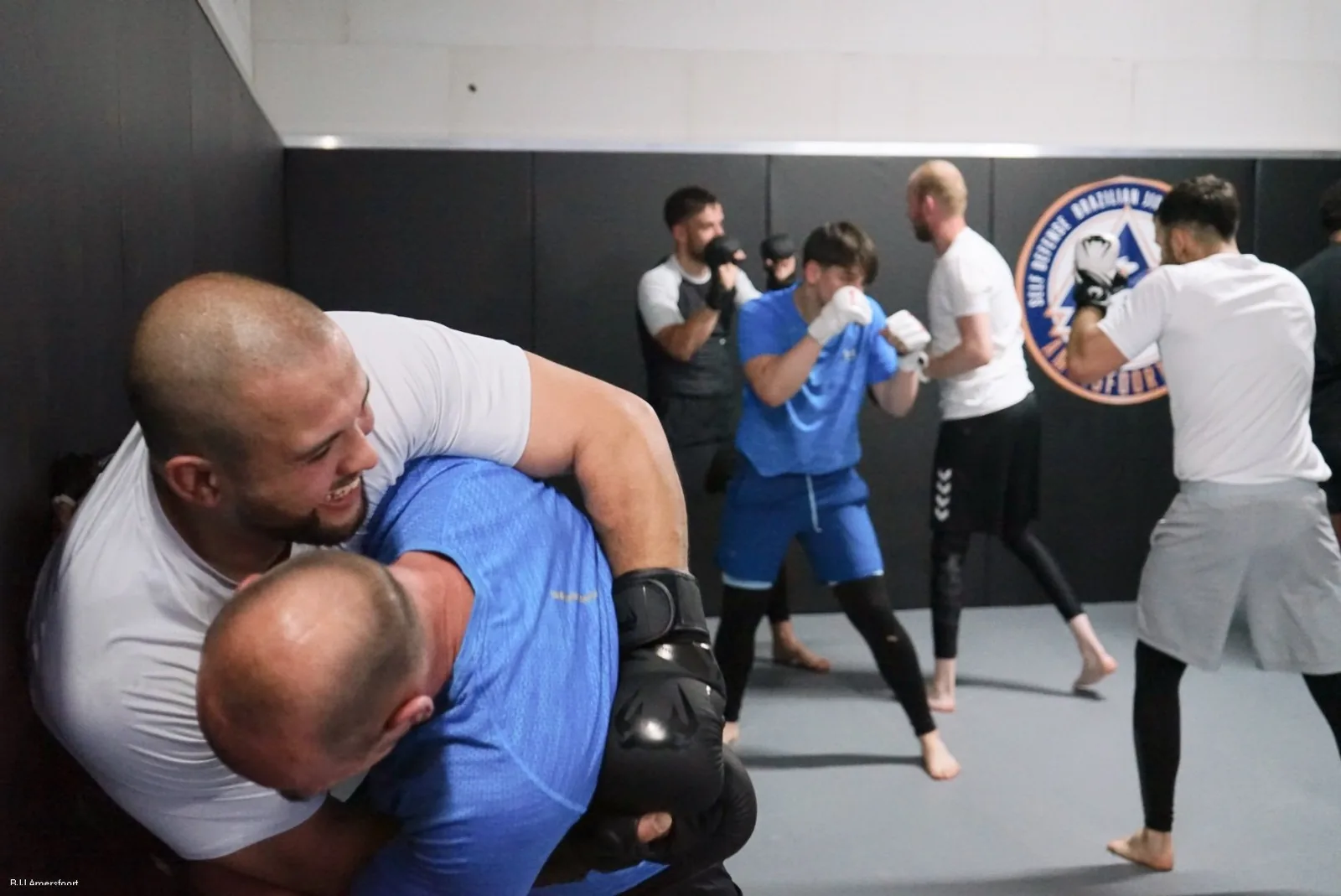
The beauty of BJJ is that you can test your techniques under resistance every class. Which makes it realistic.
During sparring, we don't hit each other.
To my knowledge, BJJ is the only martial art where you can spar with 100% intensity without hurting each other.
Of course, you can get injuries in any sport.
Japanese Jiu Jitsu generally has more styles.
BJJ can usually be divided into self-defense or Gi/No-Gi.
The style usually depends on your instructor or the philosophy of the BJJ school.
In this video, you can see what BJJ sparring looks like at the highest level.
Jiu Jitsu
Japanese Jiu Jitsu or Jujutsu focuses on unarmed opponents.
One's own strength and the opponent's momentum are used against them.
Jiujitsuka learn how to defend themselves against an attacker.
And neutralize someone through strikes or standing submissions.
Jujutsu also focuses on disarming techniques.
Modern BJJ focuses primarily on sport.
This largely depends on which BJJ lineage you follow.
Self-defense is number one at BJJ Amersfoort.
Jujutsu was a self-defense system for the unarmed samurai.
Japanese Jiu Jitsu is primarily trained in a Kata-like manner.
Kata literally means “form.” I call this detailed choreography.
There are modern Jiu Jitsu schools that participate in competitions.
They do this with the Ju-Jitsu International Federation (JJIF).
Japanese Jiu Jitsu is taught differently at each school.
Traditional schools adhere to the Takenouchi-ryu lineage.
Newer schools fall under the World Ju-Jitsu Federation (WJJF).
Below you can see an example of traditional Jiu Jitsu:
History and origin of Jiu Jitsu
Traditional Jiu Jitsu is one of the oldest martial arts.
It began somewhere between 780AD - 1200AD.
In the 13th century, it was used by the Samurai to defend themselves against armored opponents.
If they lost their weapons, they used Jiu Jitsu.
Around the 17th-century Edo period in Japan, unarmed combat systems like Jujutsu became increasingly popular.
Around this time, grappling became known as Jujutsu.
At the end of the 19th century, Jigoro Kano adapted Jujutsu.
He began to focus on the throws and submissions of Jiu Jitsu.
He named his new style "Kodokan Judo."
He founded the Kodokan Institute in Tokyo.
With this, he put modern Judo on the world map.
BJJ
The history of Brazilian Jiu Jitsu is not complete without Judo.
Japanese Judoka began to travel the world, some became stranded in Brazil.
One of those Judoka was Mitsuyo Maeda, a Judo master and prizefighter who traveled through Brazil in the 1910s and 1920s, challenging other martial artists in “challenge matches.”
Maeda, also known as Conde Koma, eventually crossed paths with Carlos Gracie, to whom he gave Jiu Jitsu lessons.
Carlos opened the world-renowned Academia Gracie in the 1920s.
That was the beginning of Brazilian Jiu Jitsu.
Helio, the weakest of the family, gave it his own twist.
The weaker could survive and win through leverage techniques.
BJJ became world news after the first UFC in 1993.
Helio's son Royce Gracie demonstrated the effectiveness of BJJ.
By defeating three opponents from different martial arts.
Boxing, wrestling, and savate.
Today, BJJ is the foundation of many martial arts.
And the fastest-growing self-defense system worldwide.
Read the full history of BJJ in this blog.
Rules
Brazilian Jiu Jitsu and Japanese Jiu Jitsu differ enormously when it comes to rules.
Unlike BJJ, which organizes many competitions worldwide every year, Japanese Jiu Jitsu generally does not have a strong sporting component, apart from some modern forms like German Ju-Jutsu.
BJJ
Brazilian Jiu Jitsu matches start standing.
Then they try to work each other to the ground.
However, what you often see is people quickly sitting down for guard.
Once on the ground, BJJ practitioners try to submit the opponent (tap out)
Or gain dominant positions to earn points.
If a BJJ practitioner submits the opponent, the match ends immediately.
If there is no submission, the match is decided based on points.
Points in BJJ are awarded for different positions and techniques, for example:
Takedowns - 2 points
Knee on belly - 2 points
Sweep - 2 points
Guard pass - 3 points
Mount - 4 points
Back mount - 4 points
There are enough organizations that organize BJJ competitions every year.
The rules are generally similar.
The largest in the Gi is the International Brazilian Jiu-Jitsu Federation (IBJJF).
No-Gi is the ADCC, also known as the grappling Olympics.
Japanese Jiu Jitsu
Traditional Japanese Jiu Jitsu has almost no competitions like BJJ.
There is one organization, the International Federation (JJIF), that organizes this.
JJIF competitions have three events:
Duo.
A pair of Jiujitsuka perform self-defense techniques that are randomly called out by a referee.
They are judged on criteria such as explosiveness, realism, control, and more.
Fighting.
This competition is divided into three parts, where fighting with strikes comes first. After that, the Jiujitsuka are only allowed to throw.
When it ends on the ground, the match can only be ended with a choke or a joint lock. Points are awarded throughout the match.
Ne-waza.
This is closer to a BJJ competition.
The Jiujitsuka start standing.
Then they try to work each other to the ground.
The goal is a joint lock or a choke.
They also get points for throws, takedowns, and dominant positions.
Below you can see highlights from the 2018 World Championships:
Belt system and progressions for BJJ
Brazilian Jiu Jitsu uses a belt system with eight colors:
White
Blue
Purple
Brown
Black
Red and black/Coral (7th degree black belt)
Red and white belt (8th degree black belt)
Red belt (9th and 10th degree black belt)
Every belt below the black belt has four stripes that indicate progress between belts.
You can see it as a checklist that you complete so that you enter the exam for your new belt with confidence.
Belt and stripe promotions can be obtained through your instructor or the organization you are affiliated with.
Every BJJ school has its own policy regarding student progression.
You may have to take exams, spar under high resistance to “earn” your belt. (This is the case at Amersfoort BJJ)
There are instructors who decide themselves whether students receive a belt.
In general, it doesn't hurt to get a refresh of techniques and take an exam.
Japanese Jiu Jitsu
Japanese Jiu Jitsu schools have different belt systems than BJJ schools.
White
Yellow
Orange
Green
Blue
Purple
Brown
Black
There are Jiu Jitsu schools where beginners wear the red belt before the white belt.
Japanese Jiu Jitsu schools generally have students perform Katas to advance to the next belt.
This is a formality and virtually without resistance.
The techniques they must know depend on the school.
How long does it take to get a black belt in Brazilian Jiu Jitsu vs Japanese Jiu Jitsu?
Earning a black belt in Brazilian Jiu Jitsu generally takes between 8 and 12 years, while earning a black belt in Japanese Jiu Jitsu generally takes 3-5 years.
What are the differences in knowledge between a BJJ black belt and a Japanese Jiu Jitsu black belt?
A black belt in Brazilian Jiu Jitsu is expected to be competent in self-defense.
Knowledge of positional control, body control, and submissions.
A black belt in Japanese Jiu Jitsu must have knowledge of throws, submissions (standing), and self-defense techniques (standing).
What does a BJJ/Jiu Jitsu class look like?
An average BJJ class is about 1 - 1.5 hours and consists of:
Warm-up with technique (5-10 minutes)
Techniques and positional sparring (50 minutes)
Sparring, or rolling in BJJ jargon (30/60 minutes)
What you learn in Japanese Jiu Jitsu depends on the school.
Example:
Warm-up + strength exercises
Striking and defense training
Breakfall training
Self-defense with partner (Kata)
Stretching
Apparel and equipment
In Brazilian Jiu Jitsu and Japanese Jiu Jitsu, everyone generally wears a Gi or kimono.
A Gi is a cotton jacket and pants, with a cotton belt that indicates your rank.
BJJ Gis are generally heavier than karate kimonos.
They are available in different colors and weights.
Japanese Jiu Jitsu Gis can generally vary from lighter karate-style Gis to heavy Judo-style Gis, depending on the school.
In BJJ, almost everyone wears a mouthguard and groin protector (cup) during rolling.
In Japanese Jiu Jitsu, wearing a groin protector is recommended.
What is the most effective style?
UFC 1 and today's UFC provide the answer to that question.
If you are looking for a martial art where training is realistic and under resistance, BJJ is the choice for you.
If you are looking for a martial art that is more traditional, know what to expect every class, and is less physically demanding.
You can consider Japanese Jiu Jitsu.
The choice is yours, or come experience it.
BJJ vs Japanese Jiu Jitsu: Pros and Cons.
BJJ
Pros
Complete self-defense system
Applicable in sports, MMA, or street confrontations
Realistic sparring under resistance
Plenty of competition opportunities
Community
Cons
It takes a long time to master
Equipment is an investment
Japanese Jiu Jitsu
Pros
Self-defense with weapons
Strikes, throws, and standing submissions
Cons
Minimal/no sparring
Few/no competition opportunities
Choreographed (not realistic)
Conclusion
As you have read, BJJ and Japanese Jiu Jitsu have similarities yet many differences.
When choosing a martial art, do so based on your goals and preferences.
You are always welcome on the mats of BJJ Amersfoort to try it for free!
This article was originally published in Dutch. Read the Dutch original.