In the first part 28 of this article, I described the rise and characteristics of modern grappling forms such as Brazilian Jiu-Jitsu, wrestling (Greco-Roman, freestyle, Sambo), submission grappling, and mixed martial arts. I advocated for offering grappling more broadly than just as judo, to align with modern movement culture. In this second part, we explore how to offer these modern grappling forms in sports, physical education, and related domains.
Methodology and didactics of grappling sports and rough-and-tumble play
Erik Hein
The structure of this article can be found in figure 3, which can also serve as a 'menu of options' for the teacher or trainer who wants to do something with grappling (rough-and-tumble play) and is looking for support in determining goals, lesson content, didactics, and methodology. The components of the figure are elaborated sequentially.
The menu of options can be used as follows:
Choose sequentially:
• a domain of grappling (rough-and-tumble play) in which you want to work;
• the most suitable source sports for you and your objective that you want to use;
What is ‘rough-and-tumble play’?
Domains and source sports Phases Basic forms Challenges Training methods
Figure 3 | Menu of options for the teacher/trainer.
• the phase of rough-and-tumble play you want to offer;
• within that phase, basic forms, rough-and-tumble challenges, or both.
• the most suitable training method: training, learning, or playing.
The concept of ‘rough-and-tumble play’
Which term do we choose for what we want to do: judo, grappling, rough-and-tumble play, wrestling? The criteria of acceptance, communication, and implementation are important here. Another criterion is that the term 'rough-and-tumble play' is not narrowed down to just one source sport, such as judo.
The term used should essentially refer to all forms of movement behavior involving a hand-to-hand fight, with the goal of throwing, controlling, and submitting. The term must also refer to broad domains, including sport and play, but also offer space and relevance to basic forms of rough-and-tumble play, self-defense, and resilience. Finally, the term must align with the current martial arts/movement culture.
Based on these criteria (in addition to the objections mentioned in part 128), judo is rejected. We could choose the term wrestling, but this has the same objections as judo, namely that we narrow it down
to one of the many source sports of grappling. The most neutral, precise, and internationally common term is 'grappling'.
In the Netherlands, however, this term is still relatively unknown. In this article and for this journal, I therefore choose the term rough-and-tumble play, because it meets all the stated criteria and is accepted in sports and physical education.
Domains and source sports
Rough-and-tumble play can be divided by purpose into various domains, namely as: play; sport; broad physical and motor development; self-defense; resilience training; psychomotor intervention.
Trainer tip:
choose the right term
Every setting – think of sports, physical education, or resilience training – is sensitive to how you name ‘rough-and-tumble play’. In physical education, rough-and-tumble play or judo is known and accepted, but in a gym in a big city, BJJ or grappling sometimes fits better. Use the term that suits your goal and context. 16
Sportgericht no. 1 | 2022 – volume 76
These domains derive their basic forms, techniques, and tactics from a number of source sports.11,31 Some source sports are better suited to certain goals than others (see table 2). In addition, the affinity of
the trainer with a source sport is also an important factor.
Rough-and-tumble play as a game
Here, playing is paramount. Think of rough-and-tumble games in physical education. Strict institutionalized competition rules and protocols are less important. Own game goals and rules can be designed. The goal is to play with opposing game challenges and keep the game going. In rough-and-tumble games, playing comes before winning.
Rough-and-tumble play as a sport
This is the competitive variant. Think of Greco-Roman or freestyle wrestling, Sambo wrestling, submission grappling, and (Brazilian) Jiu-Jitsu or judo. Here, the aim is to win against an opponent according to institutionalized competition rules. Because I sometimes hear different opinions around me, I would like to state here that competition (literal meaning: 'to strive together') is not by definition unpedagogical or unformative. Sport has its own formative values, but also its pitfalls, of course.
Rough-and-tumble play as broad physical and motor development
In this domain, the basic
forms of movement related to rough-and-tumble play are central. Think of pushing, pulling, and lifting. The emphasis is on physical strengthening and developing a broad and adaptive motor base. This domain is applied, among other things, from the ASM-BMO method at, for example, football clubs.5,28
The goal is not to train better grapplers, but more versatile athletes.
Rough-and-tumble play as (physical) self-defense
In this domain, you can think of controlling a physically aggressive person, or freeing yourself from a grip.31 Physical skills
in self-defense scenarios are central. In this domain, legal aspects such as proportional and subsidiary action play an important role. A high and hard judo throw like the ura-nage is very effective, but in many cases not proportional.
Rough-and-tumble play as resilience training
In this domain, which should not be confused with self-defense, socio-emotional and communicative goals are particularly pursued. Themes such as setting boundaries, the role of posture and body language, standing up for yourself, or conversely, adapting to another are practiced through physical rough-and-tumble forms.
Rough-and-tumble play as psychomotor intervention
Here, rough-and-tumble forms are used therapeutically for a specific
Figure 4 | The five phases of rough-and-tumble play.
problem. Rough-and-tumble play offers an extra dimension due to physical contact, which we know can be both healing and threatening. Themes include recognizing body signals, working on distance and proximity, space, strength, body awareness, trust, and relaxation.25,32
Five phases of rough-and-tumble play
Rough-and-tumble play – from grappling to judo – can be divided into five phases (see figure 4), based on distance, position, and goals:
1. standing rough-and-tumble play at long distance:
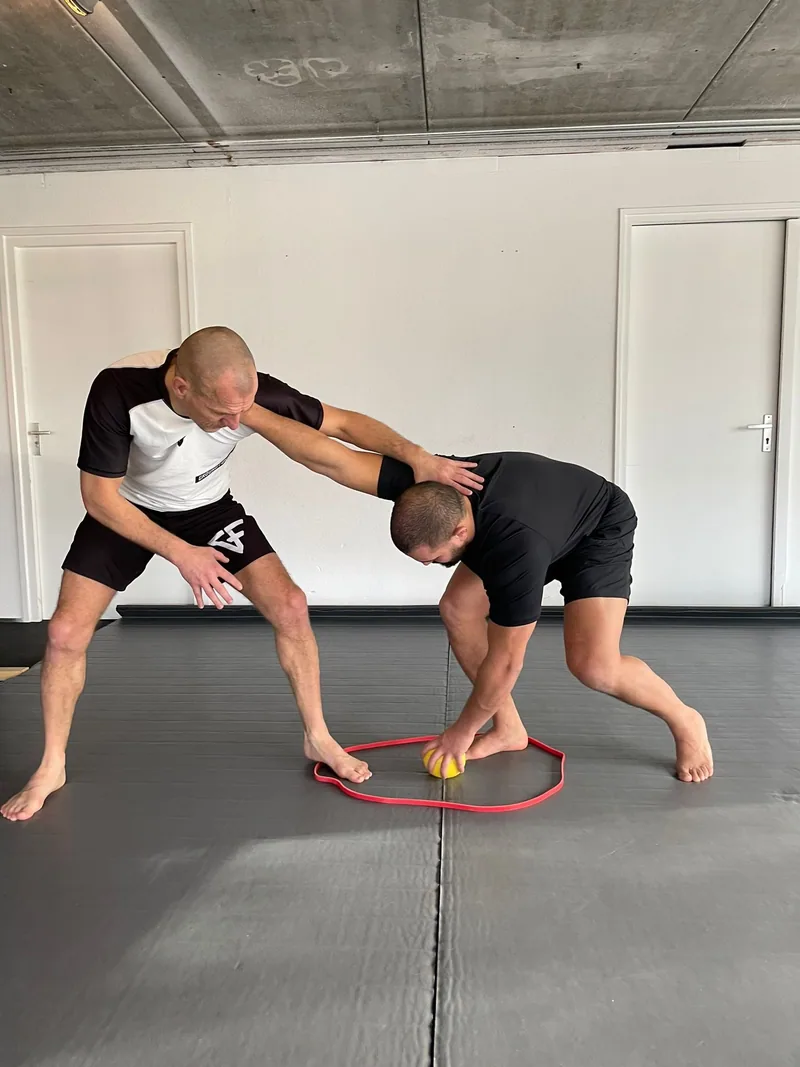
2. standing rough-and-tumble play at short distance
3. standing rough-and-tumble play – clinching
4. standing versus ground rough-and-tumble play
5. ground rough-and-tumble play (see photo 9).
SOURCE SPORT
DOMAIN: Rough-and-tumble play as ...
Greco-Roman wrestling
freestyle wrestling
Sambo wrestling
Brazilian Jiu-Jitsu
grappling
MMA
judo
play
sport
broad physical and motor development
self-defense
resilience training
psychomotor intervention
Table 2 | Suitable (•) and unsuitable (•) combinations of rough-and-tumble play domains and source sports.
Sportgericht no. 1 | 2022 – volume 76
17
TRAINING
Trainer tip: choose your domain and source sport
First choose the domain and then the most suitable source sport. If you choose rough-and-tumble play as a game, for example, this fits perfectly with training for broad physical and motor development, or in physical education. Then choose a suitable source sport. If schools or sports clubs do not have or wear a judogi, source sports such as wrestling, grappling, or BJJ no-gi are more suitable than judo. And if you want to work on 'tackles' (for example, for rugby) from the rough-and-tumble play domain, then freestyle wrestling and grappling are the best choices. If you choose rough-and-tumble play as self-defense, you are looking for expertise that goes beyond grappling sports. For example, knowledge about legal aspects of self-defense and scenario training. Brazilian Jiu-Jitsu is then very suitable, because of all grappling source sports, it has the most elaborate and explicit self-defense curriculum. Judo and wrestling are less suitable, because they do not include kicks and punches, but also some tactics that are unsuitable in the street (for example, turning onto your stomach).
phase 1 rough-and-tumble play at long distance
phase 1 entry and level change
phase 1 initiating contact
1
2
3
phase 1 contact
phase 1 end position to takedown
phase 2 standing rough-and-tumble play at short distance
4
5
6
phase 3 clinch
phase 4 standing versus ground rough-and-tumble play
phase 5 ground rough-and-tumble play
7
8
9
18
Sportgericht no. 1 | 2022 – volume 76
Phase 1
The first phase is standing rough-and-tumble play and can start from a distance and without contact. Here, a distance must be covered to make contact. Think of the phase before initiating a wrestling takedown or a rugby tackle. In this phase, distance must be covered and moving in and out plays an important role.
Phase 2
The second phase is standing rough-and-tumble play, where there is already physical contact with the hands, but no 'torso-on-torso' contact yet. This is the fight for hand and 'grip' position, as clearly seen in wrestling and judo. The hands are the most important first line of defense against takedowns. The so-called hand fight aims to get into a position where you can bring the opponent to the ground. In this phase, throwing techniques and takedowns take place. The game challenge is to throw and not be thrown, also known as 'staying in balance' versus 'unbalancing' in physical education.
Phase 3
The third phase is the so-called clinch, where there can be torso-to-torso contact. Think of the many wrestling positions, but also body-to-body positions in, for example, rugby, boxing, and kickboxing. Takedowns and throws also occur from the clinch, especially those throws that require close body contact, such as hip throws and many takedowns via underhooks and body locks.
Phase 4
In the fourth phase, one person stands and the other person sits or lies on the ground. For example, in BJJ or judo, where the 'thrower' is still standing and the opponent is on the ground. This phase is especially important in rough-and-tumble play as self-defense and also occurs frequently in physical interventions by the police, in mental health care, and in physical aggression at school. Phase 4 also offers good opportunities to get used to contact and is also relevant for all those sports and resilience situations in which you have to protect yourself while lying on the ground. BJJ and grappling have the most elaborate curriculum in this area.
Phase 5
The fifth phase is ground rough-and-tumble play, where we have previously seen (see table 1 in part 128 of this article and photos 10 to 16) that there is a hierarchy of positions. For example, the back mount (photos 10 and 11) is the most effective position, so it receives the most points in the 'sport' and 'play' domains.28
Trainer tip phase 1
Fun rough-and-tumble games for all target groups in this phase are:
• Touching the opponent's knee with fingers (easy) or palm
(difficult). Touching one knee is one point, touching two knees is two points. Start with separate roles (an attacker and a defender). Then both players can be attacker and defender simultaneously. Play the game for one minute. The one who scores the most points wins. This exercise is the basis for a 'single leg' and 'double leg' takedown and trains movement and defense.
• The same game form, with the same structure and scoring as above, but now the goal is to grab one or two of the opponent's wrists. A variation is three points if you can make one or both of the opponent's hands touch the ground. This exercise is the basis for the 'hand fight' and thus for wrestling techniques like the 'arm drag'.
Trainer tip phase 3
A fun rough-and-tumble game for all target groups in this phase is the following:
• Play for inside bicep position. One point can be earned for one side and two
points for both hands in an inside-bicep position. A variant is to put the opponent on one leg from this position (three points) or to come 'underneath' (duck under) (four points). Play the game for one minute, the one with the most points wins. This exercise is the basis for even better positions, but also for 'duck unders' and takedowns.
Trainer tip phase 4
An important and fun game form for all target groups in this phase are guard plays: • One of the players sits on the ground in an athletic stance, the other stands. The goal
of the game is to pass the legs, get behind the sitting opponent, and touch them on the inside of the shoulder. If successful, roles are swapped. The sitting player may not kick, but only fend off with their hands and keep their legs
in between. Variations include having to grab a ribbon in the collar of the sitting player, or shifting the goal to grabbing an object behind the sitting player. A difficult but important variant is to give the sitting player a second goal: trying to stand up. This exercise is the basis for all 'ground recovery skills' that can occur in many sports, but also in self-defense and resilience.
Sportgericht no. 1 | 2022 – volume 76
19
TRAINING
Building up physical contact
More generally, when it comes to rough-and-tumble play, it is important to pay attention to a good methodology for getting used to and accepting physical contact.29 Sometimes you want to work with rough-and-tumble forms with physical contact, but participants are not used to it, or for various reasons are not yet ready for it. Then determine the final phase of the rough-and-tumble play and use, for example, the build-up from figure 5.
Back mount position
Back mount position variation
Side control
Mount position
Knee on belly position
11
12
13
20
Sportgericht no. 1 | 2022 – volume 76
14
Trainer tip phase 5
In phase 5, infinitely many rough-and-tumble games can be devised, ranging from 'koala' for primary school33 to serious BJJ and submission grappling forms in sports and secondary education. Some tips and exercises:
• Be sensitive. Because ground rough-and-tumble play is the most intimate form of rough-and-tumble play, it requires
sensitivity from the trainer. One possibility is to first get used to contact standing, and only then move to this phase.
• Another option is to start on the ground with rough-and-tumble play 'with' and 'for'
materials. This shifts the focus somewhat away from working purposefully on and with the body. For example, 'towel pull' from the knees, or wrestling for a ball in a boxing position with one attacker and one defender.
• Another option is to connect with the target group's perception. Many young boys, for example, are familiar with (kick)boxing, and that can be a starting point: what can you do if a grappler dodges your punch and takes you to the ground?
• Start with the least intimate positions, such as the various guard forms. There are also fun exercises to get used to contact, such as the following from Yos Lotens in 'Educating through rough-and-tumble play'4: 'toe tag', 'sticky hands', 'Eskimo dance', 'stamping', and 'accelerate and surprise'.
• Make it attractive. Some target groups are more easily engaged if you show a 'cool trick' or a neat escape (what would you do if someone held you like that?).
10
Turtle position
Guard position
15
16
Trainer tip: choosing
rough-and-tumble challenges
In the previous stage, you chose the domain of rough-and-tumble play, the source sports, and the phases you will use. Now it's time to choose which rough-and-tumble challenges you will select for training:
• If the goal is to make participants better at
rough-and-tumble play as a game or sport, then the following challenges are important: rough-and-tumble for position, rough-and-tumble for balance, and rough-and-tumble for control.
• For getting used to physical contact, rough-and-tumble challenge 1 (see table 3) is a good start. The methodology from figure 5 can be used here.
• The challenges of rough-and-tumble for space and 'with' and 'for' materials are ideally suited if rough-and-tumble play is offered for broad physical-motor development in sports and physical education.
Figure 5 | A methodical build-up of physical contact.
Choose per situation which phase is most effective for your goal and whether this phase is (already) safe for the target group. For example, there are reasons to start on the ground in physical education, because falling is then not an issue. But in secondary education, or if you want to offer rough-and-tumble forms in sports, such as for handball players or rugby players, standing rough-and-tumble play is more suitable.
Basic forms of rough-and-tumble play
Rough-and-tumble play can be broken down into a number of basic forms, such as pushing, pulling, lifting, grabbing and holding, seizing and squeezing, embracing, falling, rolling, balancing, shielding and fending off, and 'footwork'. These basic forms can be offered as isolated physical training in game form (see table 2).
Rough-and-tumble challenges
Rough-and-tumble challenges are the game challenges within all the aforementioned domains of rough-and-tumble play. Examples
include touching versus not being touched, grabbing versus not being grabbed, controlling versus staying free.30,31 Rough-and-tumble challenges occur not only within rough-and-tumble games or grappling sports, but also, for example, within rough-and-tumble play as self-defense. Table 3 lists ten rough-and-tumble challenges. The first challenges are true game challenges; the latter are mainly socio-emotional challenges.
Training methods for rough-and-tumble play
I am currently using the term 'training methods'
as an umbrella term for didactics/methodology. Didactics concerns the manner of teaching, but also the choice of working methods. In this article, we use three working methods, namely training, learning, or playing.
Training
By training in this article, I mean drilling and repeating with the primary goal of providing a physical stimulus. Automating and ingraining already learned movements also falls under training. In this sense, training has a strong conditional and conditioning character.
Learning
By learning here, I mean acquiring or improving basic forms and techniques of rough-and-tumble play. The emphasis here is therefore on technical development and less on physical stimulus. In the context of broad motor development, a broad as possible mastery of basic forms of rough-and-tumble play is central in this category. Within this category, both a substantial/technical and a relational/game didactics can be chosen. In the language of motor learning, it is then the choice between a representational (e.g., schema theory) versus a non-representational (e.g., ecological psychology) way of teaching.34
Trainer tip: basic forms
Basic forms of rough-and-tumble play make athletes stronger, fitter, and more motorically adaptive. Choose the forms that best suit your goal, your sport, and your athletes.
To participate in rough-and-tumble play as a game or sport, separate practice of basic forms is not necessary. Through play, you practice the basic forms anyway. However, basic forms of rough-and-tumble play can be an effective physical and coordinative stimulus that benefits the game. Basic forms are also valuable for other athletes who are otherwise not interested in techniques and tactics. They can be valuable in many sports with physical contact because they occur in many situations.
Sportgericht no. 1 | 2022 – volume 76
21
TRAINING
Playing
In playing, the emphasis is on the game challenges of rough-and-tumble play, and we work solution-oriented according to the 3I method:35
– introduction and exploration of game challenge
– isolation of a few solutions
– integration into play.
For example, you introduce a rough-and-tumble game situation like: A must pass B's legs to get into a hold, B tries to prevent that. Then you let the participants 'wrestle' with this challenge within certain rules. In step 2 (isolation), you highlight a few good solutions. You discuss these, give some instruction, and briefly 'drill'. Then you let the participants try to apply what they learned again (step 3: integrate) in the starting game.
Methodology
The didactics have been discussed above. Now follows the methodology, by which I mean the sequence of subject matter and working methods. Much of this has already been discussed in the phases of rough-and-tumble play and the build-up of physical contact. All that remains is to list some important choices again:
• Which phase of rough-and-tumble play do you choose?
• Which degree of physical contact do you choose
Basic form Drilling Playing
pushing
Push each other to the other side with low to high resistance. Variations:
- standing or on knees
- body-to-body or with tackling pad
Push each other out or from the spot. Variations: - standing vs. on knees
- body-to-body or with pad
pulling
Pull each other to the other side, possibly with equipment (rope).
Pull each other into or out of a space.
bumping
Getting used to absorbing physical contact through forms like shoulder pushes, chest-to-chest jumping, etc.
Duel with shoulder pushes, standing or sitting.
lifting
Lifting from front, side, and back in sets and reps.
Relay: lift each other to the other side in continuously different ways.
grabbing/seizing and squeezing
Holding onto a towel on a pull-up bar, holding a judo mat.
Towel pulling contest, or 'who can hang longest' in teams.
embracing
Embracing from front, side, and back and lifting partner.
Both partners attack and defend, goal is to embrace the other around the torso or legs.
falling and rolling
Practice various forms of breakfalls.
Rolling as dodging incoming opponents.
warding off, blocking, and evading
Warding off, blocking, or evading incoming forces (pushes, collisions, tackles).
Warding off, blocking, and evading materials and incoming game opponents.
balancing
Practice various balance positions solo.
Chinese boxing and other pushing and pulling games on one leg.
stopping
Fend off the other with an extended arm or other 'frame'.
Defending a space by fending off with one or two arms.
bridging distance and 'level change': quickly switching
from high to medium to low body postures in defensive and offensive situations.
Solo practice of bridging distance in phase-1 of rough-and-tumble play for a takedown or for making physical contact. Practice level change solo.
Practice bridging in game form (see trainer tip basic forms). Practice level change in game form.
Table 2 | Basic forms of rough-and-tumble play as drilling and as playing.
22 Sportgericht no. 1 | 2022 – volume 76
and how do you build this up in that specific situation?
• Do boys and girls work together or
separately?36
• Do we work with gi or no-gi?
• Do you choose to offer
basic forms of rough-and-tumble play, for technique, or for play?
Finally
Grappling is challenging as a sport and contributes to physical and mental health. It is also a good basis for resilience and self-defense. Grappling offers great opportunities for broad motor development and physical resilience for athletes. In the form of rough-and-tumble games, grappling offers great opportunities in physical education and a beautiful window into different grappling cultures. # Challenge Essence
1
Rough-and-tumble play with contact
Getting used to and accepting physical contact.
2
Rough-and-tumble play for control
Controlling the other and remaining free oneself. Holding versus breaking free. Examples include attacking and defending in ground positions, holds, and standing embraces.
3
Rough-and-tumble play for space
Entering or shielding/defending a spot or space
Taking the best technical position relative to the other. Dominant grip, underhooks, etc.
4
Rough-and-tumble play for position
Rough-and-tumble play with material (think of pulling and pushing forms): this involves unintentional physical contact, as an introduction to contact with others.
5
Rough-and-tumble play 'with' and 'for' materials
Rough-and-tumble play for material: here the focus is on conquering the material, but you also touch the other to get to that material.
6
Rough-and-tumble play for balance
Throwing and not being thrown.
7
Rough-and-tumble play with social etiquette
Exploring, recognizing, and acknowledging correct social etiquette in rough-and-tumble play.
8
Rough-and-tumble play with emotions
Exploring, recognizing, and acknowledging emotions in rough-and-tumble play.
9
Rough-and-tumble play with resistance
Exploring, recognizing, and acknowledging resistance in rough-and-tumble play.
10
Rough-and-tumble play with conflicts
Exploring, recognizing, and acknowledging conflict styles in rough-and-tumble play. About the author
Erik Hein is a regular contributor to Sportgericht. He is a movement scientist, registered epidemiologist and psychologist (in training), and has many years of experience as a teacher at MBO Sport and Movement, at the National Police, and within many martial arts, resilience, fitness, and personal trainer courses. He currently works as a first responder trainer and researcher and as a lecturer at the Academy of Physical Education in Amsterdam. Last week, his book Frontline Training: Handbook for Education and Training for Frontline Workers was published by ...daM Publishers.
See the first part of this article28 for references 1 to 27.
28. Hein E (2021). The grappling (r)evolution. Hybrid martial arts have much to offer sport and physical education. Sportgericht, 75 (6), 36-43.
29. Morales J et al. (2020). Progression of combat sport activities for youth athletes. Strength and Conditioning Journal, 42 (3), 78-89.
30. Brinke G ten (2008). Rough-and-tumble games in the basic document lower secondary education. Physical education, 96 (March), 32-34.
31. Pouwels J & Dijkstra W (September 2016). Movement domain rough-and-tumble play, encounter & resilience: at ALO Eindhoven. Physical education, 104 (September), 31-30.
32. Marich J, Warren OH & Ebert P (2021). Gracie Jiu-Jitsu in trauma-focused
Table 3 | Ten rough-and-tumble challenges
This article was originally published in Dutch. Read the Dutch original.