In the past ten years, a (r)evolution has taken place in the world of martial arts. The popularity of MMA (mixed martial arts) increased enormously, and in its wake, new grappling sports gained recognition and popularity. The ancient sport of wrestling also experienced a clear resurgence. The multitude of techniques and physical attributes now required make these sports interesting in themselves, but also offer enormous possibilities for sports in
a broader sense, physical education, resilience training, and welfare work.
The grappling (r)evolution Hybrid martial arts have much to offer sports and physical education
Erik Hein
In a two-part article, I hope to generate your enthusiasm
for all these possibilities. Whether you are, for example, a strength & conditioning trainer in sports, a physical education teacher, a resilience trainer, or a psychomotor therapist, the multitude of modern martial arts variants offers something for everyone.
Introduction
In this first part, I will provide background on the rise of MMA
and – in its slipstream – several popular grappling sports, such as Brazilian Jiu-Jitsu (BJJ) and submission grappling. The resurgence of wrestling will also be discussed. In part two, I will describe the ten basic forms and five core skills of grappling and address a methodology and didactics for offering grappling in, among others, sports and physical education.
Grappling
The term grappling will not yet sound very familiar to the average Dutch sports enthusiast. The dictionary gives ‘wrestling’
as the first translation, but grappling
is much more than the wrestling (Greco-Roman or freestyle) as we traditionally know it. Of course, there is a kinship. In the martial arts world, the term grappling is a collective name for all variants in which the hand-to-hand combat, in an attempt to ‘get the opponent down,’ is central. ‘Roughhousing’ is a Dutch term that also covers the load quite well.
What is the most effective martial
art? To understand the rise of grappling sports, some historical knowledge is necessary. On November 12, 1993, the martial arts world stood still. Finally, it would become clear which form is the most effective. Who wins in a sporting fight with minimal rules: the boxer, karateka, kickboxer, kung fu practitioner, or wrestler? Or will the surprise come from another direction? More on this later, but on that fateful day, grappling sports regained their respect and would begin a worldwide ascent.
36 Sportgericht no. 6 | 2021 - volume 75
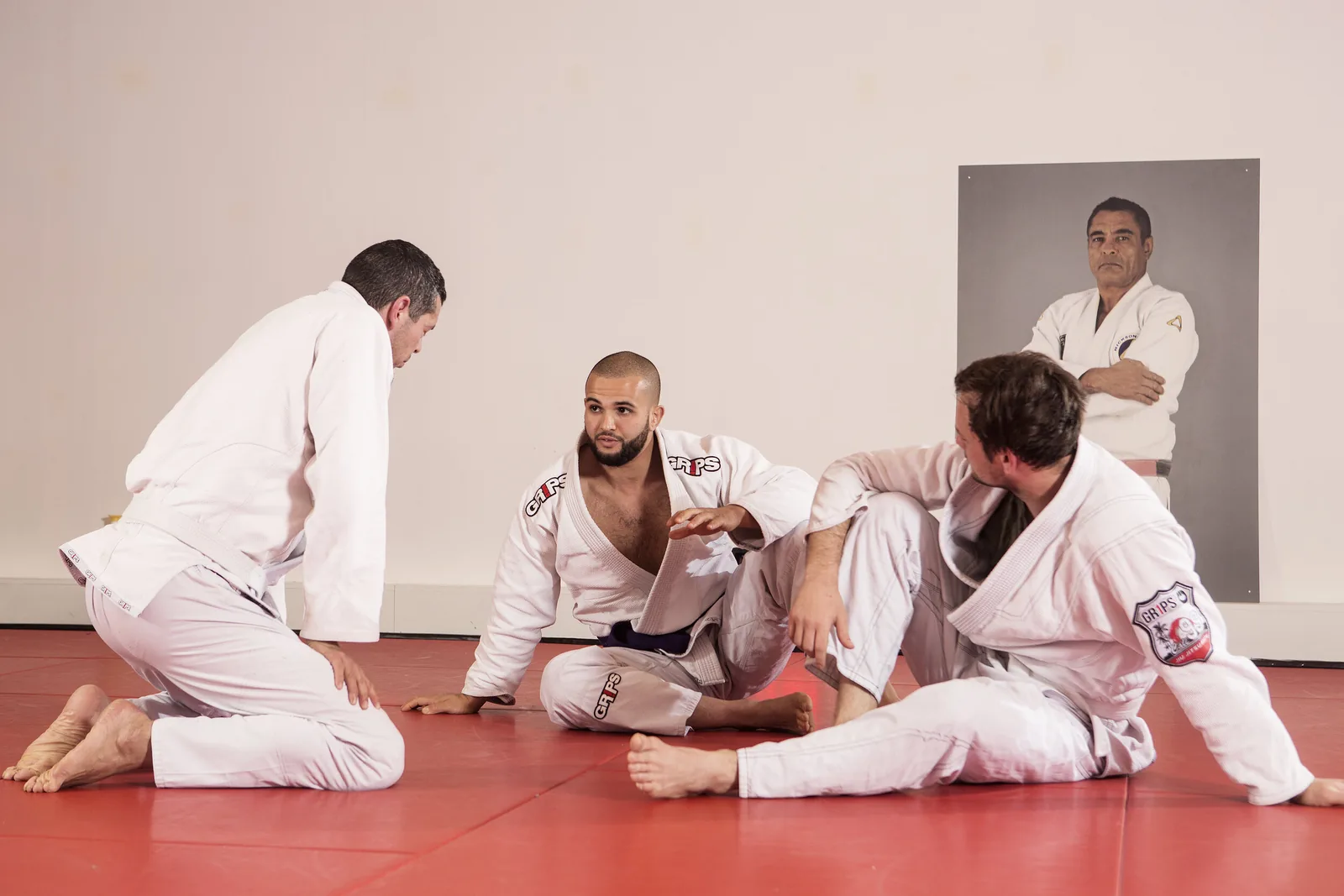
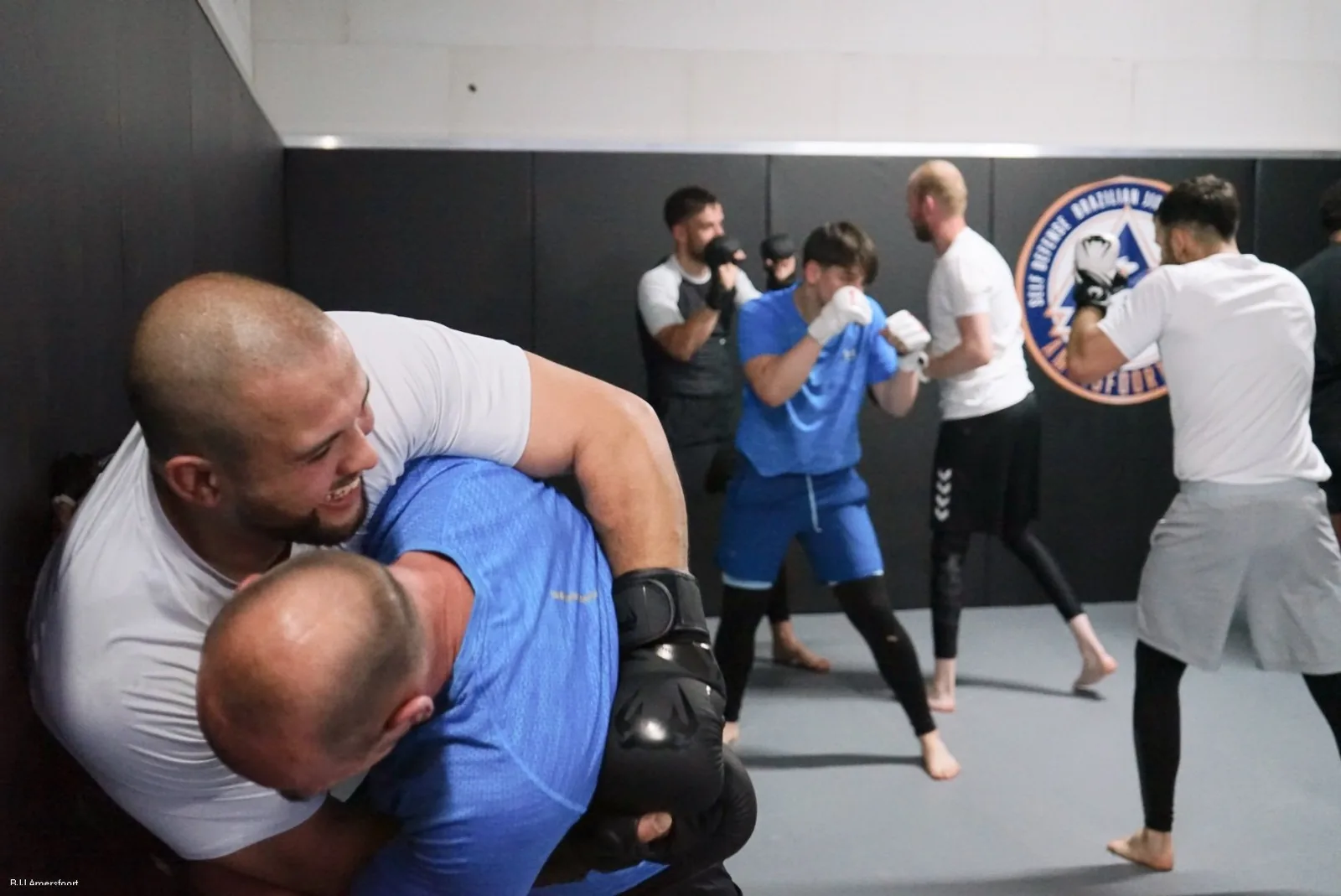
For many modern grappling forms, no special uniform is required, making them easily accessible for sports, physical education, and other applications.
but to make it plausible that grappling is much more than just judo.
Firstly, judo’s widespread popularity means that grappling is mainly associated with this specific manifestation. In physical education or in modern visions such as the Athletic Skills Model5, grappling primarily consists of judo, and other traditions remain out of sight. From the objective of providing young people in physical education and sports with a broad introduction to the existing movement culture, in my opinion, a more diverse offering than just judo is desirable. I see clear added value in providing a broader window
to the grappling world for young (but also adult) athletes, so that they not only get acquainted with Japanese martial movement culture.
With or without a uniform?
Secondly, the focus on techniques with a judo uniform (‘gi’) is a major limitation. Firstly, because in real-life self-defense situations, no one wears a uniform, and judo uniforms are almost never available in physical education. When using grappling forms as training for other athletes (such as rugby players, handball players, and footballers), uniforms are usually not available, and other wrestling forms are actually closer. Another consequence of training in a judo uniform is that many other skills,
known from other traditions, remain underexposed. Grappling without a uniform requires very different skills and places different physical demands.6 Greco-Roman wrestling, no-gi BJJ, and submission grappling are specifically focused on this and have an entire curriculum for it!
Thirdly, in judo as a competitive sport, fewer and fewer techniques are allowed than in the original curriculum. Many beautiful, effective techniques have been banned,
Hand-to-hand
As mentioned, grappling is a form of martial art in which hand-to-hand combat is central. The goal is to dominate the opponent standing or on the ground through positions, grips, and joint locks.1 Pankration was the first grappling sport in the history of the Olympic Games and is comparable to modern MMA.2 Grappling as play behavior is as old as humanity itself3, and many cultures have their own traditions. From Greco-Roman wrestling to Russian Sambo, Japanese judo
and the equally Japanese sumo. In addition to the Olympic grappling disciplines of wrestling and judo, there are many other grappling forms, including Brazilian Jiu-Jitsu and submission grappling. Grappling is also an important part of MMA.
In his book Educating through Roughhousing4, author Yos Lotens says: ‘When young people – and animals – want to let off steam, they roughhouse. But roughhousing is more than just a way to
get rid of excess energy. It is an important aspect of (movement) education.’
More than just judo
In Western Europe – but certainly not
in Eastern Europe, the immense former Soviet Union, and the USA – Olympic wrestling slowly faded in the last century. At one point, the sport had only a handful of practitioners. The
‘From the objective of providing young people in physical education and sports with a broad introduction
to the existing movement culture, in my opinion, a more diverse offering than just judo is desirable.’
grappling tradition was mainly kept alive by judo. This identification of grappling with judo unfortunately has a number of disadvantages, which I will discuss below. Not to discredit judo,
Sportgericht no. 6 | 2021 - volume 75
37
Photo: Shutterstock
TRAINING
including wrestling throws and takedowns, but also foot and leg hyperextensions. As a martial sport, judo has thus lost versatility.
Self-defense
Fourthly, judo has also lost some of its value from a self-defense perspective. It has truly become a sport, detached from reality outside the dojo. In most judo schools, there is no longer any attention paid to self-defense, and there is no longer a curriculum on this point. Moreover, typical competition tactics in judo, such as sitting in a crouch or lying defensively on your stomach, are highly undesirable in self-defense situations. The emphasis on standing throws also makes judo largely disproportionate in self-defense situations. If you fall from a throw on the street, you run a high risk of serious injury. Unlike judo, grappling forms like BJJ still have an explicit self-defense curriculum. BJJ also makes less use of hard/
high throws and is more focused on control techniques. This means that these grappling forms can be more easily used in
training apprehension and self-defense skills for civilians and law enforcement professionals. Fifthly, judo’s competition rules limit groundwork, as little time is given for it. As a result, judo has become primarily a standing form of grappling, while groundwork offers so many possibilities as a roughhousing form. Standing grappling is also physically demanding and technically difficult,
partly due to throwing and especially falling. This makes it relatively inaccessible as a training form for practitioners of other sports and especially for older athletes. Groundwork, in particular, offers many opportunities to grapple safely and without falling. The
Figure 1 | A wide variety of techniques (right) from a large number of martial arts forms (left) come together in MMA.11
American judo coach Jimmy Pedro (world champion in 1999 and four-time Olympic participant) says about this: ‘Judo is a tough sport for adults, especially with regard to falling. You have to be quite athletic for it.’ BJJ is much more accessible for older athletes.7
Grappling versus striking
Although judo, in recent decades in Western Europe, rose to become the dominant form of grappling, it, like other grappling variants, suffered from the increasing popularity of so-called striking arts: initially karate and taekwondo, later mainly kickboxing. Judo seemed more and more suitable only for children and as a pure competitive sport. Boxing, kickboxing, and karate were considered superior in an open fight compared to grappling. Until that twelfth of November in 1993. To understand that a little better, we go back in time and end up in Brazil.
The Gracie family
Entirely in the tradition of martial arts masters, the Brazilian Helio Gracie (1913-2009) was slender, light (61 kg), and in poor health. He learned jiu-jitsu and judo from Japanese masters and refined their techniques.8
In 1951, he fought the top judoka of that time, Masahiko Kimura, in a packed stadium. Helio lost the fight to a shoulder lock, which has since been called the kimura. Strengthened by this defeat, the Gracie family continued to develop their martial art – then called Gracie Jiu-Jitsu
further. They challenged everyone to face them in fights with few rules and no weight classes. It is important to note that the Gracies very deliberately sought a jiu-jitsu (‘gentle art’ or ‘flexible technique’): more emphasis on technique and less on physical strength. This philosophy would later play a role in whether or not to go along with the trend of modern physical training.
Helio’s eldest son Rorion brought the
38
Sportgericht no. 6 | 2021 - volume 75
Brazilian Jiu-Jitsu to the US, where he again challenged everyone to face him. This was recorded on video, and thus the Gracie Challenge was born. Anyone who thought their martial art was effective could test it out, with the same result every time: on your butt on the ground and tapping out to a joint lock or choke. But still, the martial arts world thought that the strikers were better than the grapplers and that karateka, taekwondo practitioners, boxers, and kickboxers would make short work of those grapplers. Until November 12, 1993, when the birth of MMA shook up the martial arts world.9
Mixed martial arts
Royce Gracie was the youngest and least physical member of the Gracie family.
Without any injury and purely on technique, on that twelfth of November, he successively defeated a boxer (Art Jimmerson), a Dutch full-contact karate top fighter (Gerard Gordeau), and a submission wrestler (Ken Shamrock). Three victories in one evening, without weight classes! Gracie would repeat this feat in several tournaments, where he also made the Dutch judoka and jiu-jitsuka Remco Pardoel from Oss tap out to a choke. How could this happen? How could such a light jiu-jitsuka win against heavier and physically stronger strikers? What exactly was he doing there on the ground? Tournament after tournament, Gracie remained the dominant fighter because no one had yet managed to solve the puzzle.
Professional martial arts
Today, almost thirty years later, MMA is one of the highest-paid and most professional martial arts, with explosive growth, competitions in the hallowed Madison Square Garden (New York), and packed stadiums on all continents. On the sports channel ESPN, record figures are achieved with pay per view. Worldwide, grapplers
as well as strikers from all martial arts disciplines dream of making their debut in MMA.
In terms of regulation, the largest MMA organization (UFC: Ultimate Fighting Championship) meets the strictest requirements, including a strict anti-doping policy, organized by the United States Anti-Doping Agency (USADA). Like boxing in the past, MMA has its own ‘Muhammad Ali’ and ‘Mike Tyson’. Only now they are called Conor McGregor and Ronda Rousey (former judo champion). In 2017, McGregor challenged the undefeated boxing world champion Floyd Mayweather in the biggest money fight of all time. He lost in the tenth round of the fight but was able to add millions of dollars to his bank account. This illustrates the immense popularity of MMA.
Sports science
In the martial arts world, MMA leads the way in sports scientific research. For example, there is the UFC Performance Institute, where state of the art training, medical and sports scientific guidance, and research take place. Dr. Duncan French is the vice president of performance of the institute and has the mission of optimizing MMA through sports science. French is also the editor of the recent ‘bible’ of the NSCA (National Strength & Conditioning Association), titled ‘NSCA’s essentials of sport science’.10 He is a student of NSCA pioneer Prof. William Kraemer and brings years of Olympic experience to MMA. In 2021, the Performance Institute released the second ‘Cross-sectional performance analysis and projection of the UFC athlete’.
Figure 2 | Vertical alignment is seen as the ideal model for integrated training of MMA skills.11
Sportgericht no. 6 | 2021 - volume 75 39
TRAINING
An impressive exercise physiological, nutritional, injury preventive, and tactical analysis of the modern all-round martial artist.11
MMA is fully present in authoritative scientific journals, including those of the NSCA. MMA is a great sports science challenge because it is a mix of striking and grappling martial arts, with sometimes opposing physical demands. One could speak of the ‘decathlon of martial arts’. These internal contradictions make MMA training a very challenging puzzle, forcing sports science to conduct research and innovate.
The first piece of the puzzle is how to integrate all these skills from different domains (see figure 1) into a coherent training program. The second piece of the puzzle is aligning (‘vertical alignment’, see figure 2) all trainers and supervisors from the many involved disciplines, i.e., preventing ‘compartmentalization’ (‘horizontal alignment’). This current sports scientific process within MMA training is very interesting for coaches in other complex sports.
The third piece of the puzzle is the physical aspect of this versatile mix. How do you harmonize the physiological requirements of all the different disciplines? For example, MMA athletes can train wrestling, but also boxing, and these activities require different physical attributes.12 In addition, there is also the supportive physical training, which must also be diverse because the standing phase has different physiological characteristics than the clinch phase and the ground fight. For those who want to read more about the exercise physiological and training-related aspects of this most comprehensive martial art, I have included a number of suggestions11-15 in the literature list. MMA has no fixed, predetermined
competition calendar. Athletes must therefore always be basically fit in case a match is offered. The majority of
athletes then go into a ‘fight camp’ for 6-12 weeks. What then is an effective periodization?16 A puzzle that will also appeal to coaches from other complex sports.
The importance of MMA
There are – just as with boxing and kickboxing previously – various ethical questions to be asked about a full-contact martial art like MMA. And those questions are certainly being asked.17 The reality, however, is that MMA – just like kickboxing before it – is very popular and apparently meets the psychological and sociological needs of practitioners18 and spectators. In the article ‘The Nordic female fighter’19, the authors see opportunities for women to use MMA as an emancipatory instrument: “MMA women have the potential to act as female role models through their counter-hegemonic negotiation of norms and views of ‘traditional’ femininity and, more specifically, the perception of femininity as something fragile and passive.
Here is MMA’s progressive potential.’ The fact is that this martial art currently attracts many athletes and recreational practitioners worldwide and has, in its wake, revitalized a large number of other martial arts (again).
Positive consequences
The rise of MMA has brought about a number of positive consequences. Firstly, due to its all-round nature, MMA has reunited the striking and grappling traditions. In physical education and sports, a distinction is currently often still made between roughhousing and striking games, but these can also be practiced integrally as combat games or combat sports. In education, you don’t have to offer these mixed forms as competitive sports; instead, they are perfectly usable as all-round self-defense games.20
Secondly, MMA has opened up, brought together, and emancipated the martial arts world. Opened up and brought together because MMA has generated tremendous interest in cross-training. Because the game is so broad and cannot be solved by one martial arts discipline, athletes
The MMA curriculum
MMA is a mix of ‘striking’ and ‘grappling,’ and these skills are nourished by many different martial arts. In terms of game flow, MMA has three phases:
The standing phase, in which mainly striking and kicking techniques and takedowns are performed at long and
shorter distances. The techniques for this phase primarily come from striking sports, with kickboxing, Muay Thai, boxing, karate, and taekwondo being dominant forms. Takedowns from freestyle wrestling also fall into this phase.
The clinch phase, or hand-to-hand combat, where the main goal is to fix, unbalance, and take the opponent to the ground. The techniques for this phase primarily come from Greco-Roman wrestling and Sambo, judo, and BJJ. Judo is an effective method here, although the techniques must be adapted because there is no judo uniform. In the clinch phase, short striking and knee techniques from kickboxing can also be applied.
In the ground phase, the goal is to force the opponent to submit, mainly through arm and leg locks, chokes, and striking techniques. If the athlete can no longer defend themselves or does not ‘tap out,’ the referee ends the fight. The techniques for this phase primarily come from wrestling, Sambo, and BJJ.
40
Sportgericht no. 6 | 2021 - volume 75
look and learn from the many individual martial arts. For striking techniques, one can study boxing, kickboxing, or karate, and for grappling, athletes look to judo, BJJ, and wrestling, among others. While martial arts were once separate worlds,
there is now continuous interaction and mutual interest and respect. Cross-training brings more people from diverse sporting and cultural backgrounds together and stimulates innovation and mutual understanding.
The aforementioned emancipation means that teachers and organizations can no longer hide behind black belts, secret techniques, and ‘the only truth’. With MMA, a common laboratory has emerged where anyone who claims their martial art is the most effective
can realistically test this. One only needs to look at the history of MMA to get an idea of what works and what doesn’t in
a sporting fight. This means that everyone can join, and hierarchical structures of belts and gurus have less influence. Nor is it only everything from the East that is worthwhile. Martial arts from the West and other parts of the world now enjoy just as much respect.
Thirdly, MMA has restored wrestling in all its cultural manifestations and given it an enormous boost. This is, of course, positive for the sport of wrestling itself, but also because it has breathed new life into a cultural heritage with physical and (developmental) psychological value.
Brazilian Jiu-Jitsu
Earlier, the origin of BJJ was described as the Gracie family’s attempt to make judo and jiu-jitsu more efficient and less physical. The four strategic steps in BJJ are as follows:21
1. Take the fight to the ground: here, strength and explosiveness play a smaller role, and dangerous impact weapons are partly neutralized;
2. Avoid your opponent’s legs, as they are dangerous; 3. Move through a hierarchy of
positions to gain the most dominant
position;
4. Force the opponent to submit through a submission: joint lock, choke, or psychological submission.
BJJ is based on a hierarchy of ground positions that represent real combat value outside BJJ as a competitive sport. The higher the hierarchical value, the more opportunities the position would offer in a real fight. Table 1 describes the hierarchy of ground positions.
As the name suggests, in the ‘top’ positions, you are ‘on top’ of the opponent, and in the ‘bottom’ positions, you are the underlying party. Top positions are high in the hierarchy; neutral positions offer possibilities to both sides. The best-known example
is the guard position: your opponent is between your legs and is indeed ‘on top,’ but you can still apply very effective sweeps and submissions. However, the opponent can also pass and work towards higher-valued positions.
‘Gi’ and ‘no-gi’
BJJ has both a ‘gi’ (with uniform) and a ‘no-gi’ (without uniform) form. Usually, both are practiced.6 The no-gi variant has a greater transfer to roughhousing games, but also to self-defense and application in MMA.
BJJ after MMA
After the start of the MMA revolution, BJJ would spread further across the world in five directions:
• as the dominant martial arts variant
within MMA;
• as an independent competitive sport; • as a resilience and self-defense method for, among others,
civilians and first responders;
• as a psychosocial intervention;
• as a roughhousing form for young and old.
BJJ in MMA
We have already discussed BJJ in MMA. Nowadays, all fighters train in the techniques,
and so BJJ is no longer dominant. There is formidable competition from wrestlers and Sambo wrestlers who have deciphered BJJ. Strikers are also increasingly able to defend against the clinch and ground fight. However, mastery of BJJ techniques is still a must in MMA!
BJJ as a sport
BJJ has developed into a competitive sport worldwide and has international
Dominant position
Neutral
Inferior position
Table 1 | Hierarchy of ground positions in BJJ.
Back mount on opponent
Mount on opponent
Knee on belly on opponent
Side control on opponent
Top turtle position
Guard top / in guard
Turtle position underneath
Side control underneath
Knee on belly underneath
Mount underneath
Back mount underneath
Sportgericht no. 6 | 2021 - volume 75 41
TRAINING
competition variants with and without a judo uniform.22,23 The International Brazilian Jiu Jitsu Federation (IBJJF) uses match times for adults of 5-10 minutes, depending on age and belt level. The match starts standing, just like in judo and wrestling. Points can be scored in that phase with throws or takedowns. Once on the ground, the fight continues. Unlike judo and wrestling, the match is not over after a throw or hold, but the fight goes on. Points are earned by gaining ground positions, and the fight is won by a submission (joint lock or choke). BJJ as a competitive sport is open to techniques from other traditions, leading to continuous global exchange with other grappling forms such as wrestling, Sambo, judo, etc. Due to the no-gi variant, BJJ is not tied to the judo uniform, making it accessible for, for example, education, sports, and all those other places where judo uniforms are not available.
BJJ as self-defense
BJJ has traditionally also focused on realistic self-defense and is used worldwide by, among others, police and military. Many BJJ organizations have a specific self-defense curriculum, with a strong emphasis on exercising control and minimal use of physical force. Because BJJ works without a uniform, there is a link with MMA, and the techniques are naturally geared towards ‘the street,’ the transfer to resilience training is easily made.
BJJ as psychosocial intervention
Gradually, research on the psychosocial possibilities of BJJ is also becoming available. Practitioners appear to learn important life skills through BJJ, with a positive transfer to everyday life.24 Mentioned are: respect for others, perseverance,
self-confidence, and healthy habits. The trainer and fellow athletes are the main influencers here. This involves primarily an implicit learning process and thus not an explicitly defined life skills program. BJJ is also successfully used as a (body-oriented) therapy and as an intervention for PTSD.25-27
BJJ as a roughhousing form for young and old
BJJ as a roughhousing game is more accessible and sustainable than standing grappling, hard throws, and frequent falling in judo or wrestling. The sport is characterized by a relaxed family atmosphere and a strong community feel. BJJ is unique due to its underlying philosophy of technique, efficiency, and control, and because BJJ also attracts older athletes for these reasons. Especially the scoring system, where you can earn points per position, makes it extremely suitable as a roughhousing game, because you can keep moving, and it doesn't stop with a hold.
The resurgence of wrestling
As described, strikers in MMA initially fell hopelessly short. As a boxer, kickboxer, or karateka, you would be on your back in no time. Freestyle and Greco-Roman wrestlers began to have more success, as they were accustomed to defending takedowns and throws. They could increasingly offer resistance to BJJ, although initially, they couldn’t handle submissions on the ground. In wrestling, you pin your opponent to the ground, and that’s it. In MMA, it only begins there, and the goal is to make your opponent tap out. Sambo wrestlers, in particular, gradually became better at the game and added intimidating leg and ankle locks.
Due to increasing professionalization and large financial flows,
it became more attractive for wrestlers to focus on MMA.
Many top Olympic-level wrestlers successfully entered the sport. As a result, wrestling regained its respect from the martial arts world. Moreover, media attention for MMA has greatly increased interest in wrestling as an independent sport. Dagestani wrestlers, in particular, have recently gained an almost mythical status, with Khabib Nurmagomedov’s victory over Conor McGregor as a highlight. Nurmagomedov is still undefeated and seems capable of easily dominating even American wrestlers with his specific Sambo techniques.
Wrestling has a rich curriculum of skills, ranging from takedowns to pins. You can practice it without a judo uniform, and it is directly applicable in sports and physical education.
Submission grappling (SG)
After the success of BJJ in MMA, other grappling forms also experienced a resurgence. Not everyone wanted to grapple in a white or blue uniform and be bound by the belt ranking system (with colored belts) of BJJ, judo, or traditional wrestling. People just wanted to duel innovatively and accessibly, with techniques that could come from anywhere. SG is therefore a mix of all possible grappling forms, which can be practiced without a uniform and without wrestling attire, but simply in a T-shirt and sports shorts. The goal is to score through throws and takedowns and especially to strive for submissions on the ground. SG most closely resembles what we generally understand as roughhousing. The sport now has worldwide organizations and competition circuits, and professionals can earn money with it. The beauty of SG is its great accessibility for grapplers from different sports.
42
Sportgericht no. 6 | 2021 - volume 75
Grappling and broad motor skill development
Grappling skills can be of positive value for other sports, for example, from the perspective of broad motor skill development. Ronald Mijzen and Ronald Joorse have been working together for 15 years in the youth academy of football club Ajax. Roughhousing/fighting is an important part of their performance program to turn youth players into all-round athletes. They use roughhousing in top-level sports for four reasons:
• Becoming ground-proof: if athletes
are not afraid of the ground and thus dare to fall, they have much more freedom in their movements. For example, you won’t perform an overhead kick if you are afraid of falling.
• Becoming contact-proof: not being afraid of the impact of other bodies during sports.
Preparation for strength training: roughhousing games are used with younger youth to functionally strengthen their bodies and as a bridge to strength training, initially with their own body weight and later with additional resistance.
Team building: because you touch each other and don't just exercise alongside each other, grappling works excellently as a team-building activity. You feel each other's bodies and thus the capacities of your teammates. Also in handball and rugby, among others, where hand-to-hand combat is a part of the sport, roughhousing can have great added value.
Just as Mijzen and Joorse use elements from other sports to train all-round athletes, they also do so with roughhousing. ‘From judo, we mainly use groundwork, but we also use forms like sumo wrestling. We don’t want to turn them into judokas, but into better movers, using all forms of roughhousing.’
The methodology Mijzen and Joorse use is as follows:
• Roughhousing with material (think of pulling and pushing forms): this involves unintended physical contact, as an introduction to contact with others;
• Roughhousing for material: here, the focus is on acquiring the material, but you naturally touch the other person to get to that material;
• Roughhousing for the body: having to hold each other and wanting to break free, thus the pure form of grappling.
Continuation
I hope that I have been able to generate your enthusiasm for grappling as an independent sport, but especially as a source of exercises for all kinds of other applications. In the second part of this article, I will elaborate further on these applications for various purposes.
About the author
Erik Hein is a regular contributor to Sportgericht. He is a movement scientist, registered epidemiologist, and psychologist (in training), and has many years of experience as a lecturer at MBO Sport and Movement, with the National Police, and within many martial arts, resilience, fitness, and personal trainer courses. He is currently working as a first responder trainer and researcher and as a lecturer at the Academy for Physical Education in Amsterdam.
1. Øvretveit K & Laginestra FB (2021). Mechanisms and trainability of peripheral fatigue in grappling. Strength and Conditioning Journal, 43 (4), 9-18.
2. Georgiou AV (2008). Pankration – A historical look at the original mixed-martial arts competition. Black Belt Magazine, April 2008, 92-97.
3. Bult P (1994). Movement education as an evolutionary problem. The development of programs for physical education and sport from an evolutionary biological perspective. Academic dissertation, University of Groningen.
4. Lotens Y (2013). Educating through roughhousing (2nd revised edition). Rijswijk: Elmar. 5. Wormhoudt R, Teunissen JW & Savelsbergh G (2013). Athletic Skills model. For optimal talent development. Arko Sports Media.
6. Pessôa Filho DM et al. (2021). Energetics contribution during no-gi Brazilian jiu jitsu sparring and its association with regional body composition. PLoS ONE, 16 (11), e0259027.
7. Lex Friedman podcast #236 – Jimmy Pedro: Judo and the forging of champions.
8. Peligro K (2003). The Gracie way: an illustrated history of the world's greatest martial arts family. Invisible Cities Press.
9. Souza-Junior TP et al. (2015). Mixed martial arts: history, physiology and training aspects. The Open Sports Sciences Journal, 8, 1-7.
10. French D & Torres-Ronda L (eds.) (2021). NSCA's essentials of sport science. Human Kinetics.
11. UFC Performance Institute (2021). A cross-sectional performance analysis and projection of the UFC athlete.
12. Plush MG et al. (2021). Developing a comprehensive testing battery for mixed martial arts. International Journal of Exercise Science, 14 (4), 941-961. 13. Andrade A et al. (2019). Physical and training characteristics of mixed martial arts athletes: systematic review. Strength & Conditioning Journal, 41, 51-63.
14. Plush MG et al. (2021). Exploring the physical and physiological characteristics relevant to mixed martial arts. Strength & Conditioning Journal, online ahead of print, doi: 10.1519/SSC.0000000000000649.
15. Plush M (2021). Understanding physical and physiological characteristics in mixed martial arts athletes. Master thesis, Edith Cowan University (AUS).
16. James LP, Kelly VG & Beckman EM (2013). Periodization for mixed martial arts. Strength & Conditioning Journal, 35 (6), 34-45.
17. Holt J & Ramsay M (eds.) (2021). The philosophy of mixed martial arts. Squaring the octagon. Routledge.
18. Green K (2016). Tales from the mat: narrating men and meaning making in the mixed martial arts gym. Journal of Contemporary Ethnography, 45 (4), 419-450.
19. Alsarve D & Tjønndal A (2019). ‘The Nordic female fighter’: exploring women’s participation in mixed martial arts in Norway and Sweden. International Review for the Sociology of Sport, 55 (4), 471-489.
20. Slaats C (1996). All-round self-defense games for secondary education (1st edition).
21. Joe Rogan Experience Podcast - JRE MMA Show #111. John Danaher.
22. Øvretveit K (2108). Anthropometric and physiological characteristics of Brazilian jiu-jitsu athletes. Journal of Strength and Conditioning Research, 32 (4), 997-1004; erratum in 32 (5), e7.
23. Andreato LV et al. (2017). Physical and physiological profiles of Brazilian jiu-jitsu athletes: a systematic review. Sports Medicine - Open, 3 (1), 9.
24. Chinkov AE & Holt NL (2016). Implicit transfer of life skills through participation in Brazilian jiu-jitsu. Journal of Applied Sport Psychology, 28 (2), 139-153.
25. Mickelsson TB (2021). Brazilian jiu-jitsu as social and psychological therapy: a systematic review. Journal of Physical Education and Sport, 21 (3), 1544-1552. 26. Weinberger K & Burraston T (2021). Benefits of Brazilian jiu-jitsu in managing post-traumatic stress disorder: a longitudinal study. Journal of Community Engagement and Scholarship, 13 (4), article 11.
27. Collura GL (2018). Brazilian jiu jitsu: a tool for veteran reassimilation. PhD dissertation, University of Florida.
This article was originally published in Dutch. Read the Dutch original.