Brazilian Jiu-Jitsu is a sport that demands a lot from you mentally and physically.
You move your body in many unconventional ways in different positions.
We sometimes make this BJJ joke.
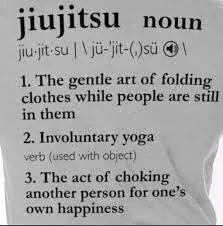
Now, back to serious business.
If you want a long BJJ career, it's wise to delve into different forms of mobility and flexibility.
After reading this blog, you'll have plenty of homework for the coming years.
We've put everything in order for you, saving you a lot of time and research.
I've already tested it for you.
Everything here works and is therefore worth your valuable time.
In this blog, we will discuss active and passive stretches for the most important joint and muscle areas where specific BJJ flexibility is needed.
We will briefly cover the differences between flexibility and mobility.
And discuss exercises you can do before and after training or on rest days.
For clarity, I am not a physiotherapist or therapist.
My expertise is Brazilian Jiu-Jitsu.
Therefore, this article is specifically focused on flexi-mobility for BJJ.
The goal is to prevent injuries for Jiu-Jitsukas.
Article content:
Mobility versus flexibility: what is the difference?
The six joints and muscles you need to stretch for Jiu-Jitsu
Active full body Brazilian Jiu-Jitsu stretches
Frequency and timing of stretching for BJJ
Why you should stretch for BJJ
Does BJJ improve flexibility?
Can you be too flexible for BJJ?
Conclusion: Stretching for BJJ
Mobility versus flexibility:
What is the difference?
The terms mobility and flexibility are often thrown around in discussions in BJJ and fitness in general.
They are often used interchangeably, but they are not equivalent terms.
Flexibility
Is "a measure of range of motion with static and dynamic components.
We divide flexibility into two components:
Static and dynamic flexibility.
Static flexibility is the range of passive movement around a joint and the surrounding muscles via external action, i.e. someone stretching your hamstring for you.
Dynamic flexibility is the range of motion available during active movements.
This is something you have to do yourself.
From a BJJ perspective, both qualities are important.
We need dynamic flexibility to perform techniques.
Since your opponent will try to force you into bad positions.
Good static flexibility is important to ensure that we don't get injured or get less injured during rolling.
This article contains stretches to improve static flexi-mobility.
Active techniques generally improve mobility, while passive techniques improve passive flexibility.
The term "flexibility" will be used in this article to refer to both principles in general.
Stretches:
Active stretching
Active stretches are exercises where you actively move your joints.
These techniques are great to use as a warm-up for a BJJ training or strength/conditioning session.
They can also be used as part of a mobility routine that you can do alongside your training, for example, in the morning after waking up or on an active rest day.
Many of the usual BJJ-specific warm-ups such as bridging and shrimping can be considered active stretching, provided you perform them with the intention to stretch.
Passive stretching
Passive stretches are exercises where you move your joint to the end range of flexibility.
You hold the position for 20 seconds or longer, right at the edge of slight discomfort.
This can be with external assistance, such as using your BJJ belt to stretch your hamstrings.
Passive stretches are best done 5-10 minutes after your training sessions when you are still warm!
Passive stretches after training improve your flexibility when performed consistently.
Logically, everything you do consistently, you become more competent in.
You can also do passive stretching while watching TV.
The 6 joints and muscle groups you need to stretch for BJJ
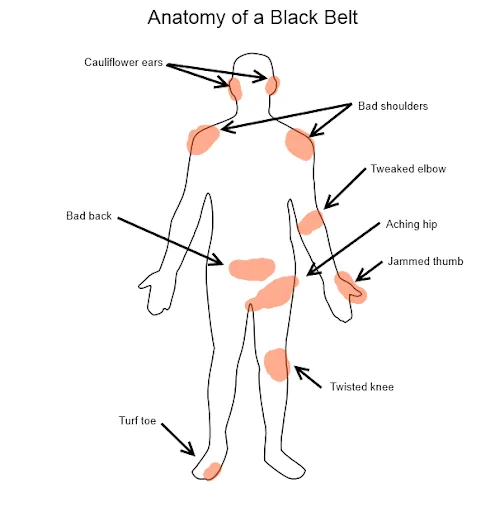
1. Ankles
Ankle mobility is crucial for BJJ, both for performing techniques and preventing injuries. Generally, stiff ankles are caused by tight calf muscles, which can limit your ability to dorsiflex your foot. The backward tension you need in your feet for strong hooks is a good example of the need for ankle mobility.
You can focus on active ankle mobility using split squats.
There are multiple variations, consider dumbbells, kettlebells, or body weight.
It depends on your goals!
Active technique
Start with a light weight (or bodyweight) and find your balance.
Step forward into a lunge and brace your core and pull your shoulder blades back.
Use your glutes and let your knee come forward for maximum effect. This will give you active ankle and hip mobility!.
Passive technique
The exercises in this video are active, but I categorize resting in the squat as passive.
Sitting in a squat for thirty minutes every day does wonders for your body.
You can do this cumulatively and spread it throughout the day.
1. Go as deep as you can. If you can't squat yet, place two books under your ankles and tear away one page each day until you achieve the position.
2. Relax your lower back and abdomen. (It's a resting position)
3. Make it a habit, you can squat anywhere.
While waiting for the bus or watching TV is usually a good time.
2. Hips
Hip mobility is crucial for BJJ.
For injury prevention and BJJ performance.
External hip rotation is needed to have both a defensive and offensive guard.
Good hip extension is needed for bridging and escaping when you get into tight positions.
Hip extension is also essential for passing guard and submissions.
To keep your hips mobile, it is advisable to apply active and passive techniques.
For your quadriceps, hamstrings, and the rotation of your hip.
In this video you will see:
1. All four hip rotations
2. Stretching your toes
3. Squats (Ido style)
Passive technique.
Kit Laughlin is a good resource if you want to stretch passively.
1. Start in this position with your back knee on the ground and the top of your foot flat on the ground.
2. Keep a neutral spine and do not lean forward with your torso.
3. Gently move your hips forward to stretch the front of your hip.
Pigeon stretch
I have a love-hate relationship with this stretch.
It is one of the best stretching exercises you will encounter.
But also one of the most painful.
1. Start with a lunge step backward.
2. Back leg on the ball of your foot
3. You can make the exercise easier or harder depending on the height of your knee and whether you use hand assistance.
Jefferson curl
Forget all other hamstring stretches, it doesn't get better than this.
1. Chin to chest
2. SLOWLY roll your spine forward
3. Return the same way you came!
With this exercise, you kill two birds with one stone (Bonus for your spine)
3. Thoracic spine (upper back)
Thoracic mobility is important to prevent injuries to the upper back and spine.
Tight pectoral muscles, latissimus dorsi, and shoulders cause a lack of
thoracic mobility and can create stiffness.
This can, in turn, put pressure on your spine.
In BJJ, you often work with a rounded upper back.
Especially when trying to defend submissions, this can cause stiffness in your upper back.
Active technique
1. Hands and knees on the ground.
2. Place one hand behind your head, do not press your neck and chin down.
3. Focus on keeping your spine as neutral as possible, breathe deeply as you rotate upwards towards the arm-behind-head side.
Passive technique
The Bretzel stretch.
1. Start by lying on your back with legs extended.
2. Bend your knee and bring it across to the other leg.
3. Bend the other knee and bring your foot towards your hip and begin to rotate.
4. Shoulders
Shoulder mobility is crucial to prevent the all-too-common shoulder injuries that many Jiu-Jitsukas suffer.
The same rounded defensive posture that causes stiffness in the thoracic region also contributes to immobility in your shoulders.
Active technique
Ido Portal is your best friend when it comes to shoulder injuries.
I have been using this shoulder routine for years with great success.
All you need is an elastic band and you can get started
(available at Action)
1. Scapula push-ups
2. Overhead straight arm pull down
3. The whippet
4. Shoulder dislocations
Passive technique.
Forget every shoulder exercise you've known for a while and start hanging. It will change your shoulders for the better forever.
Abdel, just hanging? No, not just hanging.
Hanging can be divided into three segments:
1. Passive hanging
In other words, relaxed hanging. This is usually a good start for beginners.
2. Active hanging
Active hangs are a type of strength training for your shoulders and shoulder blades. If you have a shoulder injury, this is your exercise.
3. Dynamic Hanging
This is passive and active hanging in combination.
You can create momentum and make swings like a little monkey.
http://www.idoportal.com/blog/hanging
READ this blog, it will save you a lot of shoulder pain in the coming years!
5. Neck
The neck and cervical spine can take quite a beating during BJJ.
Your neck exercises for BJJ should therefore focus on active range of motion and contribute to your overall neck strength.
There are many neck exercises, think of neck bridges, harnesses, etc.
This is the safest for beginners.
Active technique
1. Arms beside your body.
2. Put your entire body under tension.
Tighten glutes and core muscles.
Pull shoulder blades down and together.
3. Chin to chest and slowly rotate your neck in a large circle, 10-15 repetitions and 1-3 sets in each direction.
Passive technique
Passive ear-to-shoulder neck stretch.
1. Start standing, bend your ear towards your shoulder to bring the neck to stretch.
2. Arm over your head, place your hand on your ear and gently pull on your neck.
3. Do not apply too much pressure, hold for thirty seconds on each side.
6. Wrists
Wrist exercises are often overlooked by Jiu-Jitsukas.
Mobility and strength in the wrists are crucial in BJJ to prevent injuries.
Especially with the gi.
Active and passive wrist stretches should be part of your routine!
Active technique
Start on your hands and knees, bring your weight forward and let your wrists come up.
Ten repetitions up and down.
Rotate your hands and fingers, this will stretch your forearms, repeat ten times.
Passive technique
Backward wrist stretch
On your hands and knees, palms down, fingers pointing backward.
Bring your weight forward just like in the active stretch until you feel a good stretch in your forearms.
Hold for thirty seconds and repeat 1-3 times.
You can do these stretches with both wrists simultaneously or one by one.
Complete active BJJ stretching routine
The following routine can be performed before BJJ class, as a morning routine, or as active recovery on days you don't train.
You can do just one set of up to three or more, depending on time and flexibility goals.
Feel free to mix the exercises into your own routine.
Example of active full-body stretches
Neck CARS - 1-3 sets of 10 circles
Hanging - 1-8 sets of 30 seconds hold
Split squats - 1-3 sets of 10 reps
Thoracic rotations - 1-3 sets of 10 repetitions
Wrist - 1-3 sets of 10 repetitions
Passive stretching exercise after exercise or before bed
This routine is best performed after a workout while you are still warm or as relaxation before bed.
Hold each exercise for 30 seconds at a point of slight discomfort.
Perform 1-3 sets per body part. You can modify passive stretches to your liking.
You can also concentrate on the muscles that are least flexible.
Example of passive stretches after exercise / before bed
Lunge-hip flexor stretch - 30 seconds per side, 1-3 sets
Jefferson curl - 30 seconds, 1-3 sets
Pigeon stretch - 30 seconds per side, 1-3 sets
Bretzel - 30 seconds per side, 1-3 sets
Deadhang - 30 seconds 1-3 sets
Ear/shoulder neck stretch - 30 seconds per side, 1-3 sets
Hand/wrist stretch - 30 seconds per side, 1-3 sets
Frequency and timing of stretching for BJJ
Stretching or mobility is something you should do daily.
Especially if you're not the most flexible person.
The active routine can be done every day as a morning ritual.
The passive routine after training or before bed.
It's better to avoid passive stretching before a BJJ or strength and conditioning training.
Depending on your flexibility, some passive stretches can be beneficial.
But most research indicates that passive stretching can temporarily reduce maximum power output.
Why should I stretch for BJJ?
1. Reduce injuries
Reducing the risk of injuries should give you the discipline to consistently pay attention to your flexi-mobility.
So you can be on the mat every day.
A greater range of motion in the muscles around the joint allows you to handle pressure on that joint more safely.
Of course, even the most flexible BJJ practitioners will sustain injuries if joints get stuck in an awkward position.
2. Counteracting common BJJ positions and movements
Brazilian Jiu-Jitsukas (especially those who never stretch) often have muscles that are tight in areas based on BJJ movement patterns.
Usually in the hip flexors and in the upper back.
This also depends on what kind of BJJ style you have, of course.
Guard player: Rounded upper back
Open guard: Hip flexors.
Tight hip flexors, for example, can lead to lower back pain.
Tight shoulders, due to a rounded upper back, lead to limited external rotation in your shoulder. You want to "smooth" this out by stretching.
Otherwise, eventually your performance will decrease, your posture will worsen, resulting in pain and injury in your joints.
3. Safely expand your arsenal of techniques.
Everyone has their own BJJ style.
That plays a big role in how flexible you need to be for BJJ.
Personally, I am naturally a top game player.
You generally don't need too much flexibility for this.
It doesn't look fascinating, but it works.
There are plenty of BJJ world champions who have proven that this style works and you don't really need to be flexible to win. (Still work on mobility)
The newer styles, especially in no-gi, such as rubber guard, require considerable hip flexibility to perform that technique safely.
I already get lower back and knee pain just looking at that position!
But there are plenty of BJJ practitioners who have had success with it.
The creator Eddie Bravo became famous for it for that reason.
It looks interesting, and it works for some but not for everyone.
What many people don't talk about is that the people who enjoy playing this style also usually have a few hernias and bad knees.
Everything has a price.
Does BJJ improve your flexibility?
Short answer: Yes
Long answer:
This depends on your warm-ups and your BJJ style.
The positions you frequently use can all contribute to your flexibility.
Ultimately, it comes down to this: what you neglect no longer works as well, and what you overuse can get injured.
Find YOUR balance!
Can you be too flexible for BJJ?
There are certain conditions, such as hypermobility, where stretching might not be a good idea, but this most likely doesn't apply to you.
Most of us will never reach such a level of flexibility.
The biggest risk of hypermobility is losing control and strength in certain positions.
I have only encountered this twice in all my years of training.
You can improve this with a good strength training program.
Conclusion: Stretching for BJJ
Consistently working on your flexi-mobility has more advantages than disadvantages.
To name a few: injury prevention and better performance.
Try the routines above and experiment to see what feels good.
Over time, it will get better. (Everything you pay attention to)
Stay resilient, flexible, and sharp.
See you on the mat!
This article was originally published in Dutch. Read the Dutch original.