Most people have superficial knowledge when it comes to the history of Brazilian Jiu-Jitsu.
People who have never trained before might have heard that BJJ was created by the Gracie family.
Who, in turn, learned it from Mitsuyo Maeda. Is this correct?
Yes, but it's not the whole story.
The history of BJJ is complex.
The Gracies are most likely the most famous martial arts family of all time.
But there are also many others who played a crucial role in creating Jiu Jitsu.
Article contents
Before Jiu Jitsu was Jiu Jitsu
Jiu Jitsu overseas
Conde Koma and the establishment of Jiu Jitsu in Brazil
The Rise of Jiu Jitsu and the Gracie Mythology
Brazilian Jiu Jitsu in the United States
BJJ goes mainstream
BJJ today
Brazilian Jiu Jitsu history
Before Jiu Jitsu was Jiu Jitsu
Jiu Jitsu literally means gentle art.
Although the exact origins of Jiu Jitsu are difficult to trace,
it was the way of fighting in Japan in the 17th century.
During this period, warrior tribes fought regularly.
The warrior class, better known as Bushi or Samurai, refined their fighting skills into an art.
Jiu Jitsu complemented sword fighting and offered a means to incapacitate armored opponents.
The Jiu Jitsu of that time is almost entirely unrelated to our modern practice.
During the 19th century, Japan underwent a dramatic political change, which brought about the rise of the Meiji period and the accompanying national conscript army.
This led to a radical reduction in the power of the warrior class. The culmination was the disastrous samurai uprising of Saigo Takamori in 1877.
The story could have ended here.
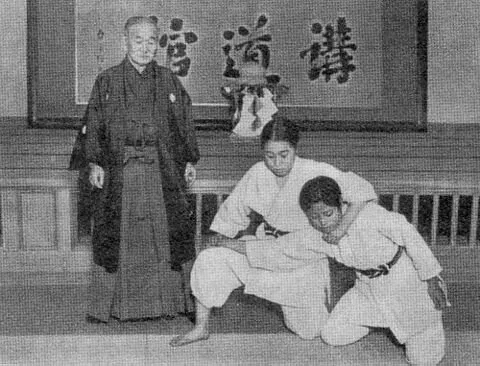
Until Jigoro Kano decided to unite the arts with other "Martial Art" enthusiasts.
Kano would become the founder of Judo.
A fighting style built on various martial arts that suited his ideals.
In the days before it was called Judo, Kano's art mainly consisted of takedowns and throws with a section of Ne-Waza, also known as groundwork.
Kano founded the Kodokan in 1882, today known as the Kodokan Judo Institute.
Jiu Jitsu overseas
In 1900, several Kano students left Japan to spread Jiu Jitsu.
Many people are familiar with the history of BJJ.
The story of Mitsuyo Maeda traveling to Brazil,
and teaching the Gracie family Jiu Jitsu.
This version of the story is not the beginning and not entirely true.
The first Jiu Jitsu instructors arrived in Brazil by accident in 1909.
The Brazilian navy cruiser Benjamin Constant spotted shipwrecked Japanese sailors during a patrol in the Pacific Ocean.
The crew was rescued and returned to Yokohama.
Three men from this crew decided to travel on to Brazil.
The three rescued sailors were Sada Miyako and Mme. Kakiara.
They were Jiu Jitsukas and instructors.
Brazil already had a long tradition regarding grappling as part of traveling circus acts.
Pre-Jiu Jitsu, Greco-Roman wrestling was the most common fighting style.
The format was quite simple:
Wrestlers offered a cash prize if you could throw them out of the ring.
Miyako saw an opportunity to make a living with Jiu Jitsu and joined a local circus group.
He started his own act, promising five pounds of gold to anyone who could throw him within three minutes.
Miyako and Kakiara left Brazil in 1910.
To their surprise, someone in Rio de Janeiro was giving Jiu Jitsu lessons.
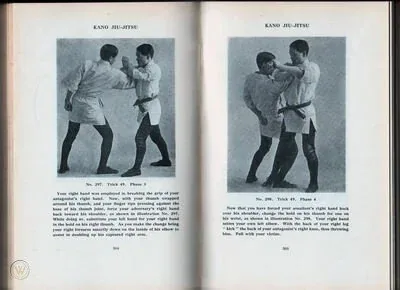
Mario Aleixo was self-taught, probably from Irving Hancock's books.
Conde Koma and the establishment of Jiu Jitsu in Brazil
The superficial history of Jiu Jitsu only covers Carlos and Helio Gracie.
Those who know a bit more will say that the brothers were taught by Mitsuyo Maeda, or as he was known in Brazil: Conde Koma.
While it is possible that this is true, this history of BJJ is very simplified and the vast majority omits the rest of the story.
Maeda is involved in the story.
But it is not entirely certain that the brothers trained with him.
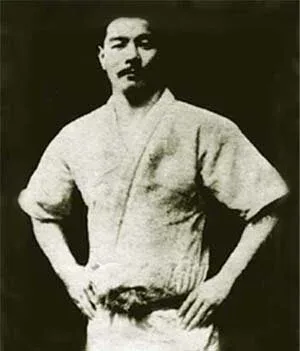
Maeda learned Jiu Jitsu in Tokyo from Jigoro Kano's student Sakujiro Yokoyama.
In 1914, Maeda and four other Kano Ju Jitsu (as it was then called) practitioners arrived in Sao Paulo, Brazil.
The group joined the circus circuit.
Like Miyako, they offered cash prizes if you could beat them in competitions.
Maeda traveled through Brazil for a few years before settling in Belem in 1920.
Here Maeda is said to have met and taught Carlos Gracie.
Depending on which source you read, Carlos may have trained with Maeda for 2 to 4 years.
Carlos may have learned his Jiu Jitsu from Donato Pires dos Reis.
The only Brazilian certified to teach Jiu Jitsu by Maeda. Depending on who tells the story, Carlos opened his own Jiu Jitsu school as early as 1925, or began teaching as an assistant instructor alongside his brother George Gracie, under Donato Pires dos Reis at the Academia de Jiu-Jitsu.
He eventually took over the school in the 1930s.
When he took over the Dojo, Carlos renamed it Academia Gracie.
Carlos claims he was already teaching Jiu Jitsu to the Minas police in March 1928.
But even Carlos's biographer refutes this theory.
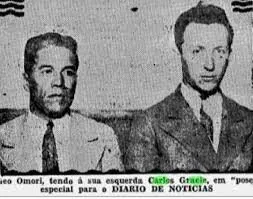
In 1929, Carlos had a demo with the best Jiu Jitsuka in Brazil, Geo Omori. After the demo, Geo is said to have stated that Carlos knew nothing about Jiu Jitsu.
The rise of Jiu Jitsu and the Gracie Methodology.
Regardless of how Carlos learned Jiu Jitsu, it is clear that he mastered the art.
In 1930 he had a second demo with Geo Omori, this time for real.
The match was declared a draw.
The newspapers reported that Carlos "mastered the techniques fantastically".
There are many stories about the rise of Gracie Jiu Jitsu.
Rorion Gracie claims that his uncle Carlos placed advertisements in the newspaper looking for opponents with headlines like:
Do you want a broken arm or rib?
Then contact Carlos Gracie.
However, this contradicts other advertisements by Carlos from that time.
In which he praised the health and spiritual benefits of Jiu Jitsu.
Around this time, Carlos's younger brother Helio came into play.
Helio was weaker but competed in swimming and rowing competitions in Rio.
Helio took over his brother George's teaching role at Academia Gracie in 1930.
George Gracie went on to teach at Donato Pires's academy in Sao Paulo.
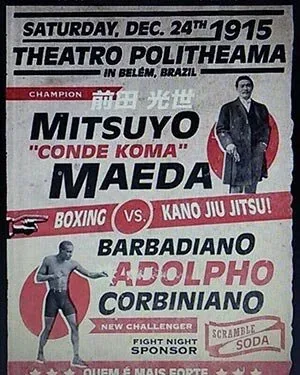
The rest of the 1930s mainly featured "challenge matches" pitting Jiu Jitsu against boxing, luta livre, capoeira, and Greco-Roman wrestling.
Carlos negotiated the terms of these fights.
The conditions were that the fight had to end in submission or KO, even if the matches lasted hours!
The following decades were not without controversy.
The Gracie brothers participated in several street fights against rival fighters.
World War II caused a shift in Brazilian sentiment towards Jiu Jitsu.
They sided with the Allies, and thus Japan and Germany were their enemies.
Brazil suffered relatively little during the war and emerged economically stronger, but for the Japanese communities in Brazil, it had lasting consequences.
This led to a decline in the popularity of Jiu Jitsu.
Which was still considered a Japanese martial art.
Many Jiu Jitsukas switched to luta livre or wrestling.
George Gracie participated in numerous pro-wrestling matches during the 1940s where the outcome was predetermined.
In the 1950s, Jiu Jitsu began to regain popularity.
Due to legendary matches by Helio against judokas Kato and Kimura, among others.
Helio won against Kato but lost to Masahiko Kimura.
Despite the loss, the matches increased the prestige of Jiu Jitsu and the Gracie family.
This was because Helio did not give up against the much stronger and heavier Kimura.
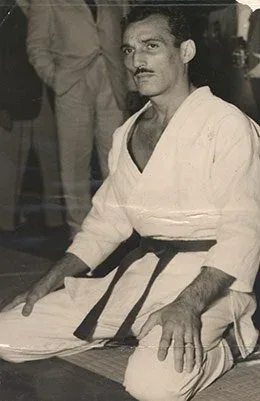
In 1951, Oswaldo Fadda founded a Jiu Jitsu school in Rio.
Fadda had less publicity and fame than the Gracies.
Nevertheless, he was an important pioneer for the sport.
The history of Brazilian Jiu Jitsu is not complete without Fadda.
Unknown coaches and Jiu Jitsu fighters from the 1950s included:
Augusto Cordeiro
Yassuiti Ono
Valdo Santana
Waldemar Santana
Almir Ribeiro
George Gracie
Takeo Yono.
In the 1950s, BJJ regulations began to change.
Helio and Carlos preferred submission.
According to critics, this was to the Gracies' advantage.
Which could sometimes take hours because Helio was always much lighter and weaker than his opponents.
Fans got bored. (to each their own)
George Gracie's solution as a promoter was to introduce a scoring system where throws and minutes-long pins each received 1 point.
The 1950s were good for the popularity of BJJ.
But Judo became an Olympic sport in 1964.
For that reason, the popularity of BJJ declined at that time.
Brazilian Jiu Jitsu in the United States
Carley Gracie became the first BJJ instructor in the United States when he began teaching at the Marine Corps base in Quantico, VA, in 1972.
Rorion Gracie traveled to California in 1978 and almost immediately began giving private lessons.
Rorion's garage training became legendary.
Reylson Gracie, who had been estranged from the Gracie family in the 1960s due to his open disdain for family traditions, opened a gym in Miami in 1979.
The 1980s were both a tragedy and a success for BJJ.
Rolls Gracie died at the age of 31 in a tragic plane crash in 1982.
Rolls, according to Helio, was the talent of the Gracie family.
Rorion's academy in Los Angeles was doing well during that period, and notably, Chuck Norris became a fan of BJJ!
BJJ goes mainstream
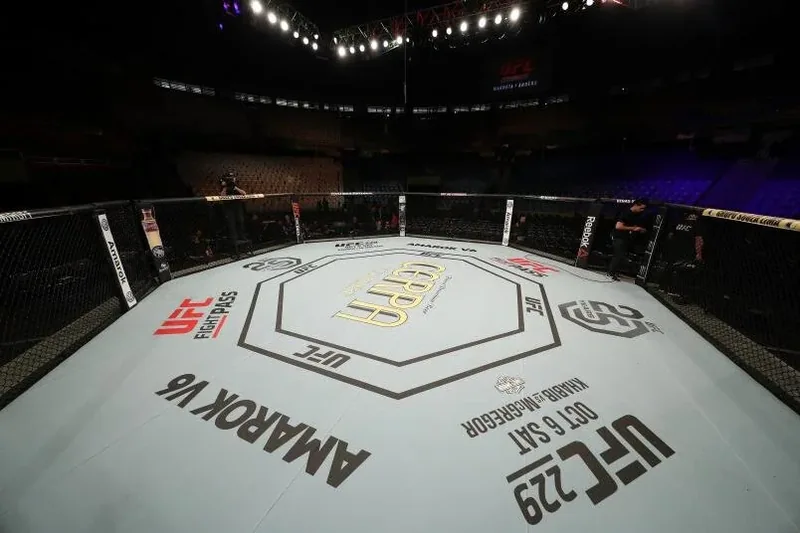
In 1993, BJJ made international news when Royce Gracie dominated in the UFC.
The UFC, co-founded by Rorion Gracie and Art Davies, launched BJJ into popular culture.
The success of the UFC contributed to the popularity of BJJ in the United States and in Brazil.
In Brazil, the opportunity to fight in the UFC was seen as a way to escape the favelas.
The first international BJJ competition appeared three years later when the Confederacao Brasileira de Jiu-Jitsu, or CBJJ (founded by Carlos Gracie Jr. and Oswaldo Alves), organized the 1996 Mundials.
The CBJJ still exists, although it is now better known as the IBJJF.
The Mundials are still considered the most prestigious Gi Brazilian Jiu Jitsu competition.
In 1999, ADCC was founded.
ADCC, founded by Sheik Tahnoon Bin Zayed, is considered the most prestigious No-gi BJJ tournament in the world.
In other words, the BJJ Olympics.
BJJ today
Over the past 20 years, BJJ has grown tremendously.
There has been an increase in academies, competitions, and organizations.
In the competition world, BJJ has grown enormously since the early days of the Mundials in 1996.
Unlike Judo, BJJ does not have a central governing body.
In some ways, the IBJJF is the standard for Gi competitions, but it is certainly not the only organization.
Other organizations such as the Sport Jiu-Jitsu International Federation (SJJIF), the Jiu-Jitsu Global Federation (JJGF), and BJJ Globetrotters offer similar services, each with a slightly different philosophy.
The SJJIF was founded in 2012 with the aim of admitting BJJ to the Olympic Games.
The JJGF was founded in 2014 by Rickson Gracie.
The goal of the JJGF is to realign BJJ with Helio Gracie's philosophies (with an emphasis on self-defense), which have been lost in modern competitive BJJ.
BJJ Globetrotters is an outlier here, as they claim not to be an organization. Founded in 2012 with the principles of inclusivity, travel, and training without affiliation, you could almost call BJJ Globetrotters an anti-organization. It's difficult to predict where BJJ is headed. It is possible that the sport will go in three directions: self-defense, gi competition, and no-gi competition.
Fortunately, at BJJ Amersfoort, you can do all three!
This article was originally published in Dutch. Read the Dutch original.